Market Research, Need Analysis and Product Planning
Chapter 02 · Automotive Product Development
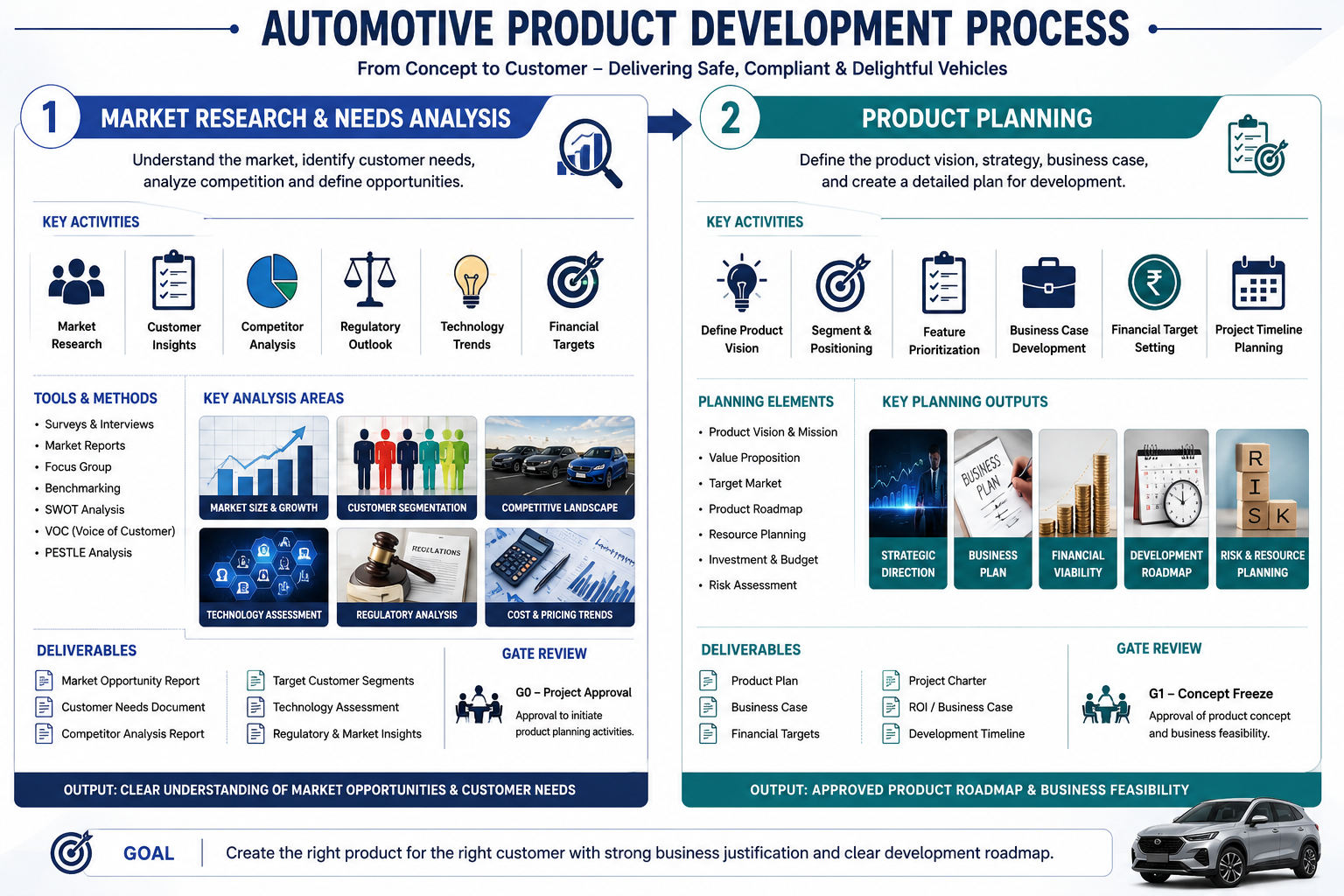
Use the infographic for the process overview, then follow the chapter sections for definitions, activities, deliverables, gate evidence, and implementation detail.
Chapter infographic
Introduction
Every successful automobile starts long before the first engineering drawing is created. Before investing millions of dollars in designing a new vehicle, manufacturers must answer several fundamental questions:
What do customers actually need?
Is there sufficient market demand?
What features will differentiate our product?
Can the vehicle be manufactured profitably?
Will it comply with future regulations?
Is the investment financially justified?
The Market Research, Needs Analysis, and Product Planning phases provide the answers to these questions. Together, they form the foundation of the Automotive Product Development Process (APDP), reducing project risk and ensuring that the right product is developed for the right customer at the right time.
Why Market Research is Important
According to industry estimates, developing a completely new passenger vehicle can require investments ranging from USD 500 million to several billion dollars, depending on vehicle complexity, platform strategy, and production scale. Even two-wheelers require significant investment in design, tooling, validation, homologation, and manufacturing.
Without a thorough understanding of the market, manufacturers risk developing products that customers do not want, that fail to meet regulatory requirements, or that cannot achieve profitability.
Effective market research enables organizations to:
- Identify genuine customer needs
- Understand market demand
- Evaluate competitor strengths and weaknesses
- Monitor emerging technologies
- Anticipate future regulations
- Estimate financial returns
- Reduce development risk
Ultimately, market research helps organizations invest in products with the highest probability of commercial success.
When a product plan introduces safety-related electrical or electronic functions, early feature definition should include the intended operating context, foreseeable hazards, and the evidence strategy described in Functional Safety (FuSa) in Automotive.
Phase 1 – Market Research & Needs Analysis
Objective
To identify market opportunities, understand customer expectations, evaluate competitors, assess regulatory requirements, and define a clear product opportunity before development begins.
Key Activities
1. Market Research
Market research provides an overall understanding of the automotive industry, customer preferences, and future business opportunities.
Activities
- Study vehicle sales trends
- Analyse market size
- Evaluate market growth
- Identify customer demographics
- Assess regional demand
- Monitor emerging mobility trends
- Understand customer buying behaviour
Data Sources
- SIAM Sales Reports
- Government Statistics
- Dealer Networks
- Market Research Agencies
- Automotive Journals
- OEM Sales Data
- Digital Analytics
2. Customer Insights
Understanding customers is the most important part of product planning.
Manufacturers collect customer feedback to identify:
- Current pain points
- Desired features
- Preferred vehicle size
- Fuel efficiency expectations
- Safety expectations
- Connectivity requirements
- Comfort requirements
- Price expectations
Methods
- Customer Surveys
- Interviews
- Online Feedback
- Social Media Monitoring
- Dealer Feedback
- Warranty Analysis
- Voice of Customer (VOC)
3. Competitor Analysis
Competitor benchmarking helps manufacturers understand where their products stand in comparison with rival brands.
Areas Evaluated
- Vehicle dimensions
- Engine performance
- Fuel economy
- Weight
- Safety features
- Infotainment
- Reliability
- Warranty
- Manufacturing cost
- Selling price
- Example
When developing a new motorcycle, OEM may benchmark:
- Honda
- Yamaha
- Suzuki
- KTM
- Triumph
- BMW
- Royal Enfield
4. Regulatory Outlook
Regulations strongly influence vehicle design.
Product planners must review both current and upcoming regulations.
Typical Regulatory Areas
- CMVR
- AIS Standards
- Bharat Stage Emission Norms
- Safety Standards
- EV Regulations
- Battery Regulations
- Recycling Requirements
- Cybersecurity
- Functional Safety
Early awareness prevents costly redesigns later in the project.
5. Technology Trends
Automotive technology evolves rapidly.
Examples include:
- Electric Vehicles
- Hybrid Powertrains
- Hydrogen Fuel Cells
- ADAS
- Connected Vehicles
- Autonomous Driving
- AI Integration
- OTA Software Updates
- Lightweight Materials
- Sustainable Manufacturing
Understanding these trends ensures that new products remain competitive throughout their lifecycle.
6. Financial Targets
A technically excellent product may still fail if it cannot meet financial objectives.
Typical financial evaluations include:
- Development Cost
- Manufacturing Cost
- Tooling Investment
- Selling Price
- Target Profit Margin
- Break-even Volume
- Return on Investment (ROI)
Tools & Methods
The following analytical tools support effective market research and needs analysis.
- Customer Surveys
Collect direct feedback from potential buyers.
Purpose
- Understand customer expectations
- Identify unmet needs
- Evaluate purchase intentions
- Market Reports
Study published industry reports.
Examples
- SIAM
- JATO Dynamics
- McKinsey
- Deloitte
- Frost & Sullivan
- Government publications
- Focus Groups
Invite representative customers to discuss products in a structured environment.
Benefits
- Understand emotional preferences
- Evaluate styling concepts
- Compare alternative designs
- Benchmarking
Compare competitor vehicles to identify strengths, weaknesses, and best practices.
Benchmarking includes:
- Performance
- Cost
- Features
- Quality
- Reliability
- Customer satisfaction
- Voice of Customer (VOC)
VOC converts customer feedback into measurable engineering requirements.
Example:
Customer Statement:
- "The motorcycle should be comfortable for long rides."
Engineering Requirement:
- Seat hardness
- Seat width
- Handlebar position
- Suspension travel
- PESTLE Analysis
PESTLE evaluates external factors affecting product development.
Key Analysis Areas
- Market Size & Growth
Evaluate:
- Current market size
- Historical growth
- Forecast demand
- Regional distribution
- Customer Segmentation
Divide customers into groups based on:
- Age
- Income
- Lifestyle
- Usage
- Geography
- Occupation
- Competitive Landscape
Analyse:
- Market share
- Product portfolio
- Pricing
- Technology
- Brand positioning
- Technology Assessment
Evaluate:
- Current technology maturity
- Emerging technologies
- Patent landscape
- Supplier capability
- Regulatory Analysis
Study:
- Existing regulations
- Future regulations
- Global harmonization
- Certification requirements
- Cost & Pricing Trends
Understand:
- Raw material costs
- Manufacturing costs
- Market pricing
- Customer affordability
Deliverables
At the end of Market Research & Needs Analysis, the following documents are prepared:
- Market Opportunity Report
- Customer Needs Document
- Competitor Analysis Report
- Target Customer Segments
- Technology Assessment Report
- Regulatory & Market Insights Report
- Gate Review – G0 Project Approval
Senior management reviews:
- Market opportunity
- Business feasibility
- Strategic alignment
- Estimated investment
- Expected return
- Major risks
Approval at Gate G0 authorizes the Product Planning phase.
Phase 2 – Product Planning
Objective
Product Planning converts market research into a structured product development strategy, defining what will be built, who it is for, how it will be positioned, and whether it can achieve technical and commercial success.
Key Activities
- Define Product Vision
Establish the long-term purpose of the product.
Example:
- "Develop India's safest middle-weight adventure motorcycle."
- Segment & Positioning
Determine:
- Target customers
- Market segment
- Brand positioning
- Competitor positioning
- Price positioning
- Feature Prioritization
Classify features based on customer value and business impact.
Examples
- ABS
- Traction Control
- TFT Display
- Bluetooth Connectivity
- Cruise Control
- Ride Modes
- Navigation
- Heated Grips
- Business Case Development
Prepare a comprehensive business case covering:
- Sales forecast
- Development investment
- Manufacturing cost
- Tooling investment
- Profitability
- ROI
- Risks
- Financial Target Setting
Define measurable financial goals:
- Target manufacturing cost
- Target selling price
- Gross margin
- Break-even volume
- Projected ROI
- Project Timeline Planning
Develop a realistic roadmap including:
- Design milestones
- Prototype builds
- Validation testing
- Homologation
- SOP
- Launch
- Planning Elements
- Product Vision & Mission
- Value Proposition
- Target Market Definition
- Product Roadmap
- Resource Planning
- Investment & Budget
- Risk Assessment
- Key Planning Outputs
The Product Planning phase produces the following strategic outputs:
Strategic Direction: A clearly defined product vision aligned with business objectives.
Business Plan: Detailed commercial and financial justification for the project.
Financial Viability: Cost targets, pricing strategy, ROI, and break-even analysis.
Development Roadmap: High-level timeline covering design, validation, homologation, SOP, and launch.
Risk & Resource Planning: Identification of technical, commercial, regulatory, and supply-chain risks, along with mitigation plans and resource allocation.
Deliverables
By the end of the Product Planning phase, the following documents are approved:
- Product Plan
- Business Case
- Financial Targets
- Project Charter
- ROI / Business Case Analysis
- Development Timeline (Master Project Schedule)
- Gate Review – G1 Concept Freeze
Senior management reviews:
- Product strategy
- Customer requirements
- Business feasibility
- Financial viability
- Development schedule
- Resource availability
- Risk assessment
Approval at Gate G1 confirms that the project is strategically sound and authorizes the Concept Development phase.
Best Practices
Base decisions on reliable market data rather than assumptions.
Involve cross-functional teams (marketing, engineering, manufacturing, finance, quality, and regulatory affairs) from the beginning.
Monitor future regulations to avoid late design changes.
Validate customer needs through multiple feedback channels.
Benchmark competitors regularly throughout development.
Review and update the business case at every major project gate.
Conclusion
Market Research, Needs Analysis, and Product Planning form the cornerstone of successful automotive product development. These phases ensure that manufacturers understand customer expectations, assess market opportunities, evaluate competition, and build a strong business case before significant engineering investment begins.
A well-executed planning process reduces project risk, aligns cross-functional teams, and establishes a clear roadmap for delivering a product that is technically robust, commercially viable, and compliant with future regulations.
Reference tables from the source chapter
| Factor | Example |
|---|---|
| Political | Import policies |
| Economic | Inflation |
| Social | Urban mobility |
| Technological | EV adoption |
| Legal | Safety regulations |
| Environmental | Emission norms |
Frequently asked questions
What is the main output of automotive product planning?
The phase should produce an approved product roadmap and business case with a defined customer, feature set, cost target, timing, volume, and regulatory direction.
How is the voice of the customer converted into engineering work?
Customer statements are translated into measurable requirements such as dimensions, performance targets, comfort values, safety functions, and price constraints.
Why review future regulations during market research?
Early regulatory visibility reduces late redesign, protects launch timing, and helps the product remain compliant throughout its intended market life.
Related articles
Phase review toolkit
Why this phase matters
Early evidence about the customer, market, regulation and business case prevents the team from optimizing a vehicle that should not be built.
Inputs, outputs and gate review
- Inputs: Customer observations, competitor data, market sizing, regulatory horizon and cost assumptions.
- Outputs: Product brief, target customer, volume and price assumptions, feature priorities and approved business case.
- Gate-review summary: Confirm that customer value, regulatory feasibility, investment and timing assumptions are evidence-based and mutually consistent.
Chapter Checklist
- Inputs are controlled and traceable
- Outputs have an accountable owner and approval status
- Open risks include containment, due date and decision authority
- Configuration and assumptions match downstream evidence
- Compliance and change impacts are recorded