Industrialization and Production Preparation
Chapter 09 · Automotive Product Development
Use the infographic for the process overview, then follow the chapter sections for definitions, activities, deliverables, gate evidence, and implementation detail.
Chapter infographic
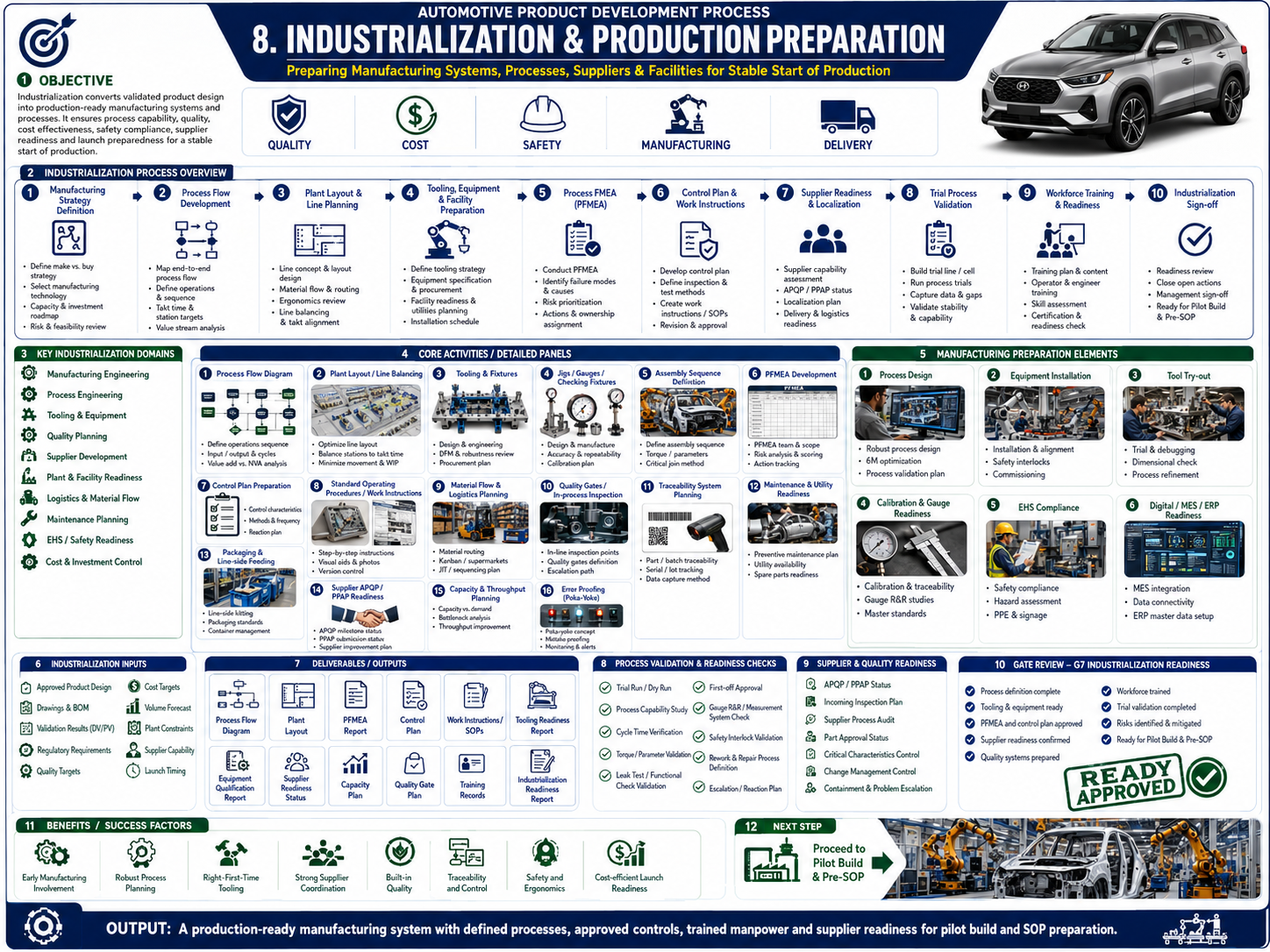
- Industrialization & Production Preparation in Automotive Product Development
- Preparing Manufacturing Systems, Processes, Suppliers and Facilities for Stable Start of Production
Industrialization and Production Preparation is the phase where the validated product design is converted into a production-ready manufacturing system. After design validation and product validation, the focus shifts from “Can the vehicle perform correctly?” to “Can we manufacture this vehicle repeatedly, safely, efficiently, and with consistent quality?”
This phase prepares the plant, equipment, tooling, suppliers, process controls, manpower, quality systems, logistics flow, and production documentation before Pilot Build, Pre-SOP and final SOP.
In simple words, this phase answers the question:
“Are we ready to manufacture this vehicle consistently at the required quality, cost, volume and timing?”
1. Objective of Industrialization & Production Preparation
The objective of Industrialization is to convert validated product design into production-ready manufacturing systems and processes.
This phase ensures:
- Process capability
- Manufacturing quality
- Cost effectiveness
- Safety compliance
- Supplier readiness
- Logistics readiness
- Facility readiness
- Workforce readiness
- Launch preparedness
- Stable Start of Production
The output of this phase is a production-ready system with defined processes, approved controls, trained manpower and supplier readiness for Pilot Build, Pre-SOP and SOP.
2. Why Industrialization is Important
A vehicle design may be technically excellent, but if it cannot be manufactured consistently, the product launch will fail.
Poor industrialization can lead to:
- Production delays
- Quality defects
- High rejection rate
- Supplier shortages
- Tooling failures
- Line stoppages
- Poor productivity
- Cost increase
- Warranty issues
- SOP delay
- Customer dissatisfaction
Industrialization prevents these risks by ensuring that the complete production system is ready before mass production starts.
3. Industrialization Process Overview
The image shows a structured 10-step industrialization process.
Step 1: Manufacturing Strategy Definition
This is the starting point of industrialization. The team defines how the product will be manufactured.
Key Activities
- Define make-or-buy strategy
- Select manufacturing technology
- Decide plant location or production line
- Define production capacity requirement
- Estimate investment requirement
- Define automation level
- Conduct risk and feasibility review
- Key Questions
Will the part be manufactured in-house or by supplier?
Can the existing plant support this product?
Is new tooling required?
Is automation required?
What is the required production volume?
What is the investment requirement?
What are the manufacturing risks?
Example
For a motorcycle, the company may decide whether frame welding will be done in-house or sourced from a supplier. For an EV, the company must decide whether battery pack assembly will be internal or outsourced.
Step 2: Process Flow Development
Process flow defines the complete manufacturing sequence from raw material to finished vehicle.
Key Activities
- Map end-to-end process flow
- Define operation sequence
- Define assembly sequence
- Define station-wise activities
- Define cycle time
- Define takt time
- Identify bottlenecks
- Conduct value stream analysis
Purpose
A clear process flow ensures that material, manpower, machines and methods are aligned.
Typical process stages may include:
- Incoming material inspection
- Sub-assembly preparation
- Main assembly
- Torque tightening
- Fluid filling
- Electrical check
- Functional inspection
- Final quality inspection
- Packing and dispatch
Step 3: Plant Layout & Line Planning
Plant layout defines how production stations, material storage, manpower movement, equipment and logistics will be physically arranged.
Key Activities
- Design line layout
- Define material flow
- Define operator movement
- Define workstation location
- Define equipment location
- Define ergonomic requirements
- Balance line as per takt time
- Minimize unnecessary movement
- Important Considerations
- Smooth material flow
- Minimum operator fatigue
- Safe movement of vehicles and parts
- Clear inspection points
- Space for rework area
- Space for tool maintenance
- Good visibility and accessibility
- Future expansion possibility
- Example
For a two-wheeler assembly line, the layout may include engine preparation, frame loading, front fork fitment, wheel fitment, brake fitment, electrical fitment, fuel filling, final inspection and dispatch.
Step 4: Tooling, Equipment & Facility Preparation
Tooling and equipment must be ready before trial production.
Key Activities
- Define tooling strategy
- Prepare equipment specifications
- Procure tools, jigs and fixtures
- Prepare gauges and checking fixtures
- Install equipment
- Validate utilities
- Plan installation schedule
- Examples of Tools and Equipment
- Assembly fixtures
- Welding fixtures
- Checking fixtures
- Torque tools
- Special service tools
- End-of-line testers
- Leak test equipment
- Press tools
- Robots
- Conveyor systems
- Battery handling equipment for EVs
Why It Matters
Even if product design is ready, production cannot start if tools and fixtures are not available, not accurate or not validated.
Step 5: Process FMEA — PFMEA
PFMEA means Process Failure Mode and Effects Analysis. It is used to identify possible failures in the manufacturing process before production starts.
Key Activities
- Conduct PFMEA workshop
- Identify process failure modes
- Identify causes and effects
- Evaluate risk priority
- Define preventive actions
- Assign responsibility
- Track action closure
- Example
PFMEA helps prevent manufacturing defects before they reach customers.
Step 6: Control Plan & Work Instructions
The Control Plan defines how the process will be controlled. Work Instructions define how operators will perform each operation.
Key Activities
- Develop control plan
- Define inspection points
- Define test methods
- Define critical parameters
- Define reaction plan
- Create SOPs and work instructions
- Approve revision control
- Train operators
- Control Plan Includes
- Product characteristic
- Process characteristic
- Control method
- Inspection frequency
- Measurement equipment
- Responsible person
- Acceptance criteria
- Reaction plan in case of failure
- Work Instructions Include
- Step-by-step operation method
- Required tools
- Torque values
- Safety precautions
- Photos or diagrams
- Quality checkpoints
- Defect examples
A good work instruction makes the process simple, repeatable and mistake-proof.
Step 7: Supplier Readiness & Localization
Supplier readiness is critical because many automotive components are sourced externally.
Key Activities
- Supplier capability assessment
- APQP review
- PPAP status review
- Localization planning
- Tool readiness review
- Supplier process audit
- Delivery and logistics readiness
- Quality readiness confirmation
- Key Supplier Readiness Points
- Supplier process capability
- Part quality level
- Tooling completion
- PPAP approval
- Capacity confirmation
- Packaging readiness
- Logistics plan
- Contingency planning
- Example
If the supplier of a brake hose is not ready, the entire vehicle assembly line can stop. Therefore, supplier readiness must be tracked very closely before pilot build and SOP.
Step 8: Trial Process Validation
Trial process validation confirms whether the manufacturing process can produce vehicles as planned.
Key Activities
- Build trial line or trial cell
- Run the process trial
- Capture data and gaps
- Validate process capability
- Verify cycle time
- Verify torque parameters
- Verify leak test results
- Check rework rate
- Validate quality gates
Purpose
This step identifies production problems before official production starts.
Typical issues found during trial production include:
- Operator difficulty
- Tool access problem
- Wrong part orientation
- Process sequence issue
- High cycle time
- Fixture mismatch
- Quality defect
- Part shortage
- Documentation gap
Step 9: Workforce Training & Readiness
A production system is only successful when operators, supervisors, quality inspectors and maintenance teams are trained.
Key Activities
- Prepare training plan
- Prepare training content
- Conduct operator training
- Conduct supervisor training
- Conduct quality inspector training
- Conduct maintenance training
- Conduct skill assessment
- Certify trained operators
- Confirm readiness
- Training Topics
- Assembly sequence
- Work instructions
- Safety rules
- Quality checkpoints
- Torque tool usage
- EOL testing
- Defect identification
- Rework procedure
- Emergency handling
- EV high-voltage safety, where applicable
Training reduces human error and improves first-time-right quality.
Step 10: Industrialization Sign-Off
Industrialization sign-off is the formal approval that the manufacturing system is ready for pilot build and Pre-SOP.
Key Activities
- Conduct readiness review
- Review open issues
- Confirm tooling readiness
- Confirm supplier readiness
- Confirm manpower readiness
- Confirm quality system readiness
- Obtain management approval
- Release for pilot build and Pre-SOP
At this stage, the plant should be ready to build vehicles under controlled production conditions.
4. Key Industrialization Domains
Industrialization is a cross-functional activity involving several domains.
5. Core Industrialization Activities in Detail
The image highlights several detailed activities required for production preparation.
5.1 Process Flow Diagram
A Process Flow Diagram shows the complete manufacturing sequence.
It helps define:
- Operation sequence
- Input and output at each stage
- Value-added and non-value-added activities
- Inspection points
- Material movement
- Rework loops
5.2 Plant Layout / Line Balancing
Line balancing ensures that each workstation has a balanced workload.
It helps to:
- Optimize takt time
- Reduce bottlenecks
- Minimize waiting time
- Improve productivity
- Reduce work-in-progress
- Improve operator utilization
5.3 Tooling & Fixtures
Tooling and fixtures ensure repeatability and accuracy.
Examples
- Welding fixtures
- Assembly fixtures
- Locating fixtures
- Checking fixtures
- Holding fixtures
- End-of-line test fixtures
Good fixture design improves dimensional accuracy and reduces operator dependency.
5.4 Jigs / Gauges / Checking Fixtures
Gauges and checking fixtures are used for dimensional verification.
They ensure:
- Part accuracy
- Assembly fitment
- Repeatability
- Quality consistency
- Fast inspection
5.5 Assembly Sequence Definition
The assembly sequence defines the correct order of operations.
It must consider:
- Safety
- Tool access
- Part fitment
- Ergonomics
- Quality checkpoints
- Rework possibility
- Cycle time
Wrong assembly sequence can create defects and increase production time.
5.6 PFMEA Development
PFMEA identifies possible process failures and defines preventive controls.
It must be linked with:
- Process Flow Diagram
- Control Plan
- Work Instructions
- Quality Gates
- Reaction Plan
5.7 Control Plan Preparation
The Control Plan ensures that important product and process characteristics are monitored.
It defines:
What to check
How to check
- When to check
- Who will check
What action to take if there is failure
5.8 Standard Operating Procedures / Work Instructions
SOPs and work instructions standardize the production method.
They support:
- Operator training
- Process repeatability
- Quality consistency
- Audit readiness
- Knowledge transfer
5.9 Material Flow & Logistics Planning
Material flow planning ensures that the right parts are available at the right station at the right time.
It includes:
- Material routing
- Storage location
- Line-side feeding
- Kanban system
- Supermarket concept
- Packaging standard
- Container management
- Internal logistics
5.10 Quality Gates / In-Process Inspection
Quality gates prevent defects from moving to the next stage.
Examples
- Incoming inspection
- Sub-assembly inspection
- Torque verification
- Electrical check
- Leak test
- Functional test
- Final inspection
- Pre-dispatch inspection
5.11 Traceability System Planning
Traceability helps track parts, batches, process data and inspection records.
It includes:
- Part traceability
- Batch traceability
- Serial number tracking
- Barcode / QR code tracking
- Data capture method
- Test result recording
Traceability is important for quality investigation, warranty analysis, recall management and COP.
5.12 Maintenance & Utility Readiness
Production equipment must be reliable and utilities must be available.
It includes:
- Preventive maintenance plan
- Spare parts readiness
- Utility availability
- Compressed air
- Electricity
- Water
- Cooling systems
- Equipment calibration
- Breakdown response plan
5.13 Packaging & Line-Side Feeding
Good packaging prevents part damage and improves productivity.
It includes:
- Line-side kit planning
- Returnable packaging
- Supplier packaging standard
- Container management
- Part identification
- Handling safety
5.14 Supplier APQP / PPAP Readiness
APQP and PPAP confirm that suppliers are ready for production.
APQP
Advanced Product Quality Planning ensures proper planning from design to production.
PPAP
Production Part Approval Process confirms that supplier parts meet design and quality requirements.
PPAP may include:
- Part submission warrant
- Dimensional results
- Material results
- Process capability
- Control plan
- PFMEA
- Measurement system analysis
- Appearance approval, where applicable
5.15 Capacity & Throughput Planning
Capacity planning confirms whether the plant and suppliers can meet production demand.
It includes:
- Production volume forecast
- Takt time
- Cycle time
- Bottleneck analysis
- Manpower planning
- Equipment capacity
- Supplier capacity
- Overtime requirement
- Shift planning
5.16 Error Proofing / Poka-Yoke
Poka-Yoke means mistake-proofing.
Examples
- Connector shape preventing wrong fitment
- Barcode scan before assembly
- Torque tool interlock
- Sensor-based part presence check
- Wrong-part detection
- Colour coding
- Software lock for missed operation
Error proofing improves first-time-right quality.
6. Manufacturing Preparation Elements
Process Design
Process design ensures the production process is robust, efficient and repeatable.
Key points:
- Process sequence
- Cycle time
- Value stream
- Quality checkpoints
- Operator workload
- Rework method
- Equipment Installation
Equipment installation includes:
- Machine installation
- Alignment
- Safety interlock check
- Utility connection
- Commissioning
- Trial run
- Tool Try-Out
Tool try-out validates whether tools, dies, fixtures and gauges can produce acceptable parts.
It includes:
- Trial and debugging
- Dimensional check
- Process refinement
- Tool correction
- Final approval
- Calibration & Gauge Readiness
Measurement devices must be calibrated before production.
Examples
- Vernier callipers
- Micrometres
- Torque wrenches
- Pressure gauges
- Height gauges
- Checking fixtures
- Leak testers
Without calibrated gauges, inspection results cannot be trusted.
- EHS Compliance
EHS means Environment, Health and Safety.
It includes:
- Safety compliance
- Hazard assessment
- PPE availability
- Safety signage
- Fire safety
- Chemical handling
- Ergonomic safety
- Machine guarding
- Emergency response plan
- Digital / MES / ERP Readiness
Modern production depends on digital systems.
It includes:
- MES integration
- ERP master data setup
- BOM upload
- Routing setup
- Production order system
- Inventory control
- Traceability system
- Data connectivity
- Quality data capture
7. Industrialization Inputs
Before industrialization starts, the following inputs are required:
8. Deliverables / Outputs
The key deliverables of Industrialization and Production Preparation are:
These deliverables are required for Pilot Build, Pre-SOP and SOP approval.
9. Process Validation & Readiness Checks
Before pilot build, the process must be validated through readiness checks.
Key checks include:
- Trial run / dry run
- First-off approval
- Process capability study
- Cycle time verification
- Torque parameter validation
- Leak test validation
- Functional check validation
- Gauge repeatability and reproducibility
- Safety interlock validation
- Rework and repair process definition
- Escalation and reaction plan
These checks confirm that production processes are stable and capable.
10. Supplier & Quality Readiness
Supplier and quality readiness is one of the strongest success factors for launch.
- Supplier Readiness Checks
- APQP status
- PPAP status
- Tool readiness
- Capacity confirmation
- Packaging readiness
- Logistics readiness
- Quality approval
- Change control readiness
- Quality Readiness Checks
- Incoming inspection plan
- In-process inspection plan
- Final inspection plan
- Supplier process audit
- Critical characteristic control
- Non-conformance handling
- Problem escalation system
- Containment process
A strong supplier and quality readiness system prevents launch-time failures.
11. Gate Review – G7 Industrialization Readiness
The Industrialization phase ends with G7 – Industrialization Readiness.
Purpose
To confirm that manufacturing processes, equipment, suppliers, manpower, controls and quality systems are ready for Pilot Build and Pre-SOP.
- Gate Review Checklist
- Process definition complete
- Tooling and equipment ready
- PFMEA completed and actions closed
- Control plan approved
- Work instructions prepared
- Operators trained
- Supplier readiness confirmed
- Quality system prepared
- Trial validation completed
- Risks identified and mitigated
- Ready for Pilot Build and Pre-SOP
If all points are satisfactory, the project receives industrialization approval.
12. Benefits and Success Factors
Effective industrialization provides several benefits.
Key Success Factors
- Early manufacturing involvement
- Robust process planning
- Right-first-time tooling
- Strong supplier coordination
- Built-in quality
- Traceability and control
- Safety and ergonomics
- Cost-efficient launch readiness
- Cross-functional communication
- Clear ownership of open issues
Benefits
13. Practical Example: Motorcycle Industrialization
For a motorcycle project, industrialization may include:
- Frame welding fixture readiness
- Engine assembly fixture readiness
- Brake hose routing process
- ABS modulator assembly process
- Wiring harness routing and clipping process
- Fuel tank assembly and leak check
- Headlamp and indicator assembly
- Torque control for safety-critical fasteners
- Chain alignment process
- Wheel alignment process
- EOL electrical check
- Noise and emission production readiness
- Packing and dispatch process
Common risks include wiring harness damage, brake hose wrong routing, fastener missing, wrong torque, fuel leakage, part mismatch and supplier delay.
14. Practical Example: Passenger Car Industrialization
For a passenger car, industrialization may include:
- Body shop line setup
- Welding robot programming
- Paint shop process validation
- Trim and final assembly line readiness
- Engine and transmission installation process
- Door fitment and gap control
- Seat and interior assembly
- HVAC filling process
- Wheel alignment
- Brake fluid filling and bleeding
- EOL diagnostics
- Water leak test
- Road test process
- Final vehicle inspection
Car industrialization is complex due to large number of parts, high automation, strict dimensional requirements and high customer quality expectations.
15. Practical Example: EV Industrialization
For an electric vehicle, industrialization requires additional focus on:
- Battery pack assembly readiness
- High-voltage cable routing
- HV safety tools
- Insulation resistance testing
- Battery handling equipment
- Thermal management filling process
- Charger and inverter installation
- BMS flashing and diagnostics
- Fire safety preparation
- Operator high-voltage training
- EV-specific EOL testing
- Charging test process
- Battery traceability system
EV industrialization requires special controls for safety, traceability, thermal management and software configuration.
16. Common Industrialization Risks
Typical risks include:
- Tooling delay
- Equipment installation delay
- Supplier PPAP delay
- Incomplete work instructions
- Operator training gap
- Poor line balancing
- High cycle time
- Part shortage
- Incorrect ERP master data
- Inadequate gauges
- Poor traceability
- Safety non-compliance
- High rejection rate
- Rework process not defined
- Process capability not achieved
- Late engineering change
- Quality gate not effective
These risks should be monitored through a launch readiness tracker.
17. Best Practices
For effective Industrialization and Production Preparation, OEMs and suppliers should follow these best practices:
Involve manufacturing engineering early during design stage.
Start supplier APQP and PPAP tracking early.
Freeze product design before tooling release.
Prepare detailed process flow and PFMEA.
Link PFMEA with Control Plan and Work Instructions.
Validate tools and fixtures before pilot build.
Conduct dry run and trial production.
Train operators before actual build.
Use poka-yoke for critical processes.
Maintain traceability for safety and regulatory parts.
Review capacity and bottlenecks.
Confirm ERP, MES and EOL readiness.
Conduct formal industrialization gate review.
Track all open points until closure.
Conclusion
Industrialization and Production Preparation is the bridge between product validation and real manufacturing. It ensures that the vehicle can be produced consistently, safely, efficiently and at the required quality level.
This phase prepares manufacturing processes, plant layout, tooling, equipment, suppliers, manpower, quality systems, logistics flow and digital systems before Pilot Build, Pre-SOP and SOP.
A well-executed industrialization phase reduces launch delays, improves quality, controls cost, prevents production failures and supports stable Start of Production.
The final output of this phase is:
A production-ready manufacturing system with defined processes, approved controls, trained manpower and supplier readiness for Pilot Build and SOP preparation.
Key Takeaways
Industrialization converts validated product design into a production-ready manufacturing system.
Key activities include process planning, plant layout, tooling, PFMEA, control plan, supplier readiness, trial validation and workforce training.
PFMEA, Control Plan and Work Instructions are critical documents.
Supplier APQP / PPAP readiness is essential for launch success.
Trial process validation confirms process capability before Pilot Build.
G7 Industrialization Readiness confirms readiness for Pilot Build and Pre-SOP.
Reference tables from the source chapter
| Process Step | Possible Failure Mode | Effect |
|---|---|---|
| Brake hose fitment | Incorrect routing | Brake hose damage |
| Bolt tightening | Under-torque | Part loosening |
| Connector fitment | Loose connection | Electrical failure |
| Fluid filling | Under-fill | Overheating or system failure |
| Wheel alignment | Incorrect alignment | Handling issue |
Reference table 2
| Domain | Role |
|---|---|
| Manufacturing Engineering | Develop process, layout, equipment and assembly method |
| Process Engineering | Define sequence, cycle time, process control and capability |
| Tooling & Equipment | Prepare tools, fixtures, gauges and machines |
| Quality Planning | Define inspection, control plan, quality gates and audit system |
| Supplier Development | Ensure supplier process and part readiness |
| Plant & Facility Readiness | Ensure utilities, space, safety and infrastructure readiness |
| Logistics & Material Flow | Ensure correct parts reach correct station at correct time |
| Maintenance Planning | Ensure equipment reliability and spare readiness |
| EHS / Safety Readiness | Ensure safe working conditions and compliance |
| Cost & Investment Control | Monitor investment, launch cost and manufacturing cost |
Reference table 3
| Input | Purpose |
|---|---|
| Approved Product Design | Final design for production preparation |
| Drawings & BOM | Manufacturing and supplier reference |
| Validation Results | Confirms product design maturity |
| Regulatory Requirements | Ensures process supports compliance |
| Quality Targets | Defines inspection and defect targets |
| Cost Targets | Controls manufacturing cost |
| Volume Forecast | Defines capacity and takt time |
| Plant Constraints | Identifies existing facility limitations |
| Supplier Capability | Confirms part sourcing readiness |
| Launch Timing | Defines industrialization schedule |
Reference table 4
| Deliverable | Purpose |
|---|---|
| Process Flow Diagram | Defines manufacturing sequence |
| Plant Layout | Defines production line and facility arrangement |
| PFMEA Report | Identifies and controls process risks |
| Control Plan | Defines process and product control method |
| Work Instructions / SOPs | Standardizes operator work |
| Tooling Readiness Report | Confirms tools and fixtures are ready |
| Equipment Qualification Report | Confirms equipment capability |
| Supplier Readiness Status | Confirms supplier production readiness |
| Capacity Plan | Confirms volume readiness |
| Quality Gate Plan | Defines in-process and final inspection points |
| Training Records | Confirms manpower readiness |
| Industrialization Readiness Report | Summarizes complete readiness status |
Reference table 5
| Area | Benefit |
|---|---|
| Quality | Fewer production defects |
| Cost | Reduced rework and scrap |
| Delivery | On time launch support |
| Safety | Safer workplace and process |
| Supplier Management | Improved part availability |
| Productivity | Better line efficiency |
| Customer Satisfaction | Stable product quality |
| Compliance | Better COP and audit readiness |
Frequently asked questions
What is automotive industrialization?
It converts the approved vehicle design into repeatable manufacturing processes, equipment, controls, supplier flows, documentation, and trained operations.
How do PFMEA and the control plan work together?
PFMEA identifies process risks and required prevention or detection controls; the control plan turns those controls into operational checks, frequencies, methods, and reactions.
What proves industrialization readiness?
Evidence includes capable trial processes, qualified tooling, approved work instructions, calibrated gauges, supplier status, trained people, traceability, quality controls, and closed critical risks.
Related articles
Phase review toolkit
Why this phase matters
Industrialization determines whether a validated design can be produced repeatedly at the required quality, rate and cost.
Inputs, outputs and gate review
- Inputs: Released product definition, process concept, volume, quality targets, supplier plan and regulatory controls.
- Outputs: Capable tooling, processes, suppliers, work instructions, PFMEA, control plan and trained teams.
- Gate-review summary: Confirm process capability, measurement readiness, supplier maturity, traceability and reaction plans before pilot build.
Chapter Checklist
- Inputs are controlled and traceable
- Outputs have an accountable owner and approval status
- Open risks include containment, due date and decision authority
- Configuration and assumptions match downstream evidence
- Compliance and change impacts are recorded