Connected Cars: Architecture, V2X, Telematics, Cybersecurity & Smart Mobility
Engineering Deep Dives · AutoPDP
Telematics, cloud connectivity, V2X, remote diagnostics, OTA, cybersecurity and connected mobility services.
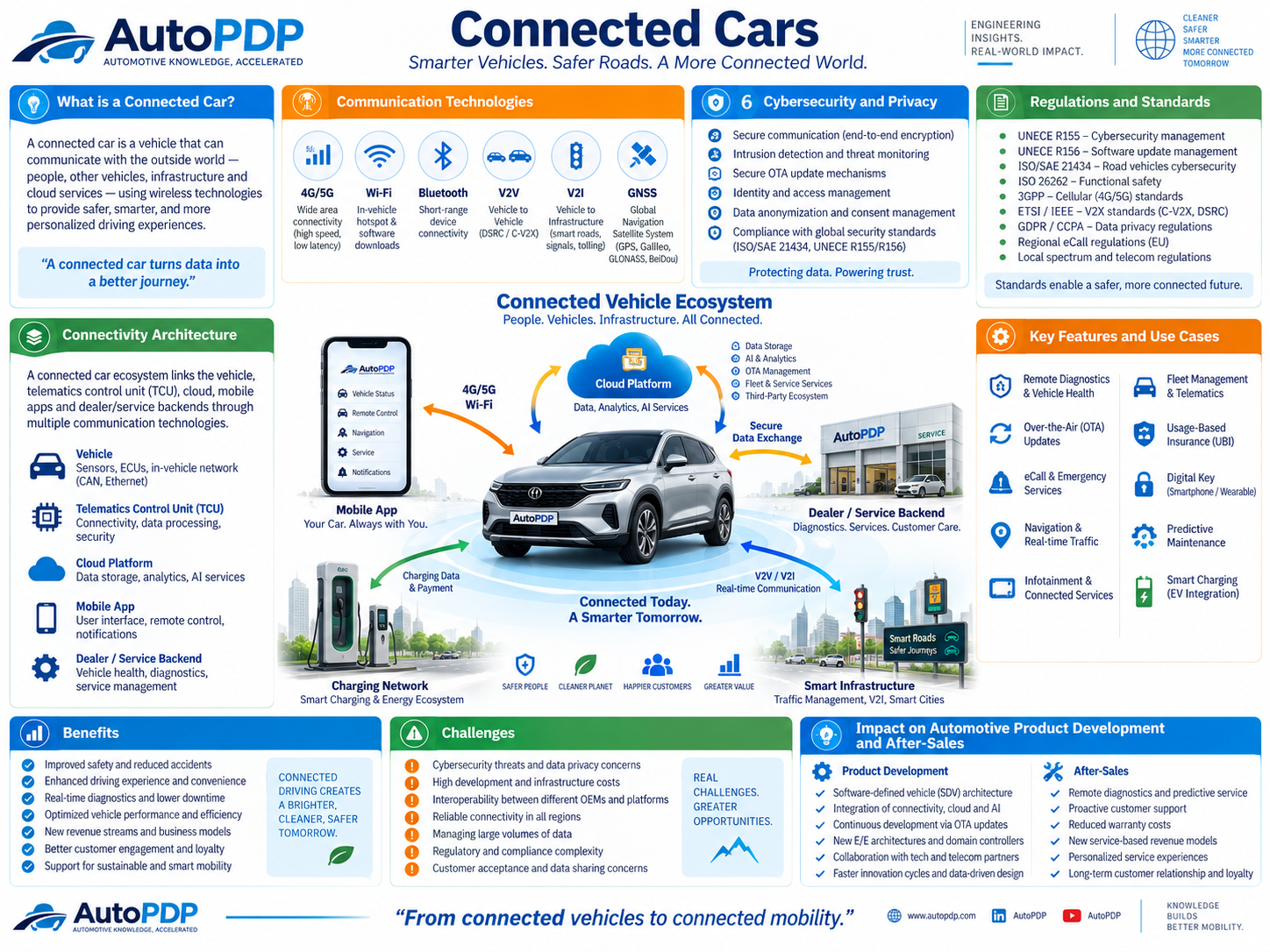
What this article covers
- Telematics, cloud services, V2X and remote diagnostics
- Data, privacy, cybersecurity and service operations
- Validation, approval, production provisioning and lifecycle support
Smarter Vehicles, Safer Roads and a More Connected World
A Connected Car is a vehicle that can communicate with external systems—including people, other vehicles, infrastructure, cloud platforms, mobile devices and service networks—through wireless communication technologies.
Connectivity transforms the automobile from an isolated mechanical/electronic product into part of a broader digital mobility ecosystem.
AutoPDP perspective: A connected car turns vehicle data into safer mobility, smarter services and a better customer journey.
1. What Is a Connected Car?
A connected vehicle combines the physical vehicle with:
- Telematics hardware
- Wireless networks
- Cloud services
- Mobile applications
- Dealer/service systems
- Vehicle-to-everything communication
- Digital identity and security
- Data analytics
- OTA software management
The vehicle can both send data and receive information or services.
Examples include:
- Remote vehicle status
- Emergency call
- Real-time navigation
- Remote diagnostics
- OTA software updates
- Fleet management
- Predictive maintenance
- Digital key
- Smart charging
- V2X safety messages
2. Connected Vehicle Ecosystem
A connected-car ecosystem usually includes:
Vehicle → TCU / Connectivity Gateway → Wireless Network → Cloud → Apps / Dealer / Infrastructure
The information flow is two-way.
Vehicle
Generates data through:
- Sensors
- ECUs
- Diagnostics
- CAN / Ethernet networks
- Battery and powertrain systems
- ADAS systems
Telematics Control Unit (TCU)
The TCU provides:
- Cellular connectivity
- Data processing
- Cloud communication
- Security functions
- GNSS positioning
- Remote-service connectivity
Cloud Platform
Cloud services may provide:
- Data storage
- Analytics
- AI services
- OTA orchestration
- Fleet services
- Digital twins
- Third-party integrations
Mobile App
Customer applications may support:
- Vehicle status
- Lock/unlock
- Charging status
- Navigation
- Service booking
- Notifications
- Vehicle location
Dealer / Service Backend
Connected vehicle data can support:
- Remote diagnostics
- Maintenance planning
- Service scheduling
- Customer support
- Vehicle-health monitoring
Smart Infrastructure
The vehicle may exchange information with:
- Roadside units
- Traffic signals
- Smart roads
- Smart-city systems
- Charging infrastructure
3. Communication Technologies
3.1 4G / 5G
Cellular networks provide wide-area vehicle connectivity.
Typical uses:
- Telematics
- Cloud communication
- Streaming
- Remote diagnostics
- Navigation
- OTA updates
- Fleet services
5G can support higher bandwidth and lower latency, depending on deployment and service.
3.2 Wi-Fi
Wi-Fi can support:
- In-vehicle hotspot
- High-bandwidth software downloads
- Workshop connectivity
- Local device connectivity
3.3 Bluetooth
Bluetooth is typically used for:
- Smartphone pairing
- Audio
- Hands-free calling
- Digital key
- Wearables
- Short-range user interaction
3.4 V2V – Vehicle-to-Vehicle
Vehicles exchange information such as:
- Position
- Speed
- Direction
- Braking events
- Hazard warnings
V2V can extend awareness beyond onboard line-of-sight perception.
3.5 V2I – Vehicle-to-Infrastructure
Vehicles communicate with:
- Traffic lights
- Roadside units
- Tolling systems
- Traffic-management systems
- Smart-road infrastructure
3.6 V2X – Vehicle-to-Everything
V2X is the broader umbrella covering communication between the vehicle and:
- Vehicles
- Infrastructure
- Pedestrians / vulnerable road users
- Networks
- Cloud services
Technologies may include C-V2X and other regionally supported communication approaches.
3.7 GNSS
GNSS provides location and timing information using systems such as:
- GPS
- Galileo
- GLONASS
- BeiDou
It supports navigation, fleet services, eCall, telematics and V2X applications.
4. Connected Vehicle Architecture
Place the communication interfaces within Vehicle Architecture & System Design.
A practical architecture includes the following layers.
In-Vehicle Layer
- Sensors
- ECUs
- CAN / LIN / Ethernet
- Gateway
- Diagnostics
- ADAS
- Battery and powertrain systems
Connectivity Layer
- TCU
- Cellular modem
- Wi-Fi
- Bluetooth
- GNSS
- V2X radio
Security Layer
- Hardware security
- Secure boot
- Cryptographic keys
- Authentication
- Secure communication
Cloud Layer
- Vehicle data platform
- Device management
- OTA services
- Analytics
- Digital twin
- Fleet management
Application Layer
- Mobile apps
- Dealer tools
- Service portals
- Fleet dashboards
- Customer digital services
5. Telematics Control Unit (TCU)
The TCU is a central component of connected-car architecture.
Typical TCU functions include:
- Cellular communication
- GNSS positioning
- Vehicle data collection
- Secure communication
- Remote commands
- eCall support
- OTA connectivity
- Diagnostics communication
The TCU usually interacts with the vehicle gateway or Ethernet/CAN network while maintaining secure communication with backend systems.
6. Cloud & Backend
Connected vehicles depend on backend infrastructure for lifecycle services.
Typical backend capabilities include:
- Vehicle registration and identity
- Data ingestion
- Data storage
- Analytics
- Remote diagnostics
- OTA campaign management
- Feature activation
- Fleet monitoring
- Customer-service integration
- Cybersecurity monitoring
Cloud architecture should be scalable because a large connected fleet can produce significant volumes of data.
7. Key Connected-Car Features
Remote Diagnostics
Vehicle faults and health data can be analyzed remotely.
Benefits:
- Faster diagnosis
- Reduced workshop time
- Proactive service
- Better warranty analysis
Fleet Management
Fleet operators can monitor:
- Location
- Vehicle usage
- Driver behavior
- Fuel / energy consumption
- Maintenance state
- Route efficiency
OTA Updates
Software can be updated remotely to:
- Fix bugs
- Improve functionality
- Patch vulnerabilities
- Update calibration
- Add supported features
Usage-Based Insurance
Driving or usage data may be used for insurance models, subject to privacy and regulatory requirements.
eCall / Emergency Services
Connected systems can automatically or manually request emergency support.
Digital Key
Mobile devices or wearables may be used for vehicle access and authorization.
Navigation & Live Traffic
Cloud-connected navigation can use real-time traffic and map services.
Predictive Maintenance
Data trends can help predict failures before a breakdown occurs.
Infotainment & Digital Services
Connected platforms enable streaming, applications and online services.
Smart Charging
Connected EVs can interact with:
- Charging networks
- Payment systems
- Energy providers
- Smart-grid services
- Charging schedules
8. Cybersecurity
Connectivity increases the attack surface of the vehicle.
Potential attack paths include:
- Cellular modem
- Wi-Fi
- Bluetooth
- V2X interfaces
- Mobile apps
- Cloud APIs
- Diagnostic interfaces
- OTA systems
Security engineering should consider:
- End-to-end encryption
- Authentication
- Secure boot
- Key management
- Intrusion detection
- Threat monitoring
- Secure OTA
- Vulnerability management
- Incident response
- Identity and access management
ISO/SAE 21434 is an important cybersecurity engineering framework for road vehicles.
9. Privacy
Connected vehicles may process:
- Location
- Driving behavior
- Vehicle identity
- Customer account information
- Service history
- Usage patterns
Data governance should therefore consider:
- Purpose limitation
- Consent
- Access control
- Data minimization
- Retention
- Anonymization / pseudonymization
- Regional privacy law
Privacy requirements vary by market.
10. Software Update Management
Connected vehicles make OTA updates possible, but OTA requires strong governance.
A controlled update process should address:
- Update definition
- Vehicle compatibility
- Cybersecurity assessment
- Safety impact assessment
- Regulatory impact assessment
- Validation
- Campaign targeting
- Secure download
- Installation
- Confirmation
- Rollback / recovery
- Record keeping
UNECE R156, where applicable, addresses software-update management and Software Update Management Systems (SUMS).
11. Cybersecurity Management
UNECE R155, where applicable, establishes a regulatory framework for vehicle cybersecurity management and Cyber Security Management Systems (CSMS).
Connected vehicle programs therefore need lifecycle processes for:
- Threat and risk assessment
- Security requirements
- Supplier cybersecurity
- Monitoring
- Vulnerability management
- Incident response
- Evidence and records
12. Functional Safety
Connected functions can interact with safety-related vehicle systems.
ISO 26262 becomes relevant where electrical/electronic faults may lead to hazardous behavior.
Examples:
- Remote vehicle control
- Smart charging
- Connected ADAS
- Emergency services
- Vehicle control commands
Connectivity architecture should therefore maintain clear separation and safety controls between convenience functions and safety-critical functions.
13. V2X and Cooperative Mobility
V2X enables the vehicle to obtain information that onboard sensors may not yet perceive.
Example:
A vehicle approaching an intersection may receive information about:
- Signal phase
- An approaching vehicle hidden by a building
- Road hazard
- Emergency vehicle
- Queue ahead
Connected awareness can therefore complement onboard ADAS sensors.
The longer-term direction is:
ADAS + Connectivity + V2X + Cloud = Cooperative Intelligent Mobility
14. Connected Car vs Software-Defined Vehicle
Explore the broader compute and software lifecycle in the Software-Defined Vehicle deep dive.
The terms are related but different.
| Connected Car | Software-Defined Vehicle |
|---|---|
| Focuses on vehicle communication | Focuses on software-defined functionality |
| Requires external connectivity | Can include both onboard and offboard software |
| Enables cloud services | Enables continuous feature evolution |
| TCU/cloud are key elements | Central compute, middleware and APIs are key elements |
| Supports OTA | OTA is part of a broader software lifecycle |
A connected-car architecture is an important enabler for many SDV capabilities.
15. Connected Car and ADAS Integration
Read the ADAS deep dive for sensing, fusion and driver-assistance validation.
Traditional ADAS relies primarily on onboard perception.
Connected ADAS can supplement that data with information from:
- Other vehicles
- Infrastructure
- Cloud traffic systems
- Smart intersections
This may improve situational awareness, although safety-critical functions must always be engineered for the reliability and availability of the intended data sources.
16. Connected EVs
Electric vehicles are strong candidates for connected services because software and energy management are already central to the platform.
Common connected EV use cases include:
- Remote state-of-charge
- Charging notifications
- Charger search
- Charge scheduling
- Battery pre-conditioning
- Energy consumption analytics
- Remote climate control
- Battery-health monitoring
- Smart-grid integration
17. Impact on Automotive Product Development
Connected Cars alter the traditional APDP lifecycle.
| APDP Phase | Connectivity Impact |
|---|---|
| Market Research | Identify digital-service expectations |
| Product Planning | Connected-service roadmap and business model |
| Concept | Connectivity use cases |
| Architecture | TCU, gateway, cloud and cybersecurity architecture |
| Detailed Design | Hardware/software/backend interfaces |
| Prototype | App, cloud and vehicle integration |
| DV/PV | Connectivity, network, security and end-to-end validation |
| Homologation | Telecom, cybersecurity, privacy and update requirements |
| Industrialization | Provisioning, certificates, SIM/eSIM and software flashing |
| SOP | Production backend activation and baseline control |
| Mass Production | Connected fleet monitoring |
| COP | Configuration/change control |
| Market Feedback | Real-world data and remote diagnostics |
18. Impact on Manufacturing
Production must manage digital identity in addition to physical assembly.
Typical production data may include:
- VIN
- ECU identifiers
- TCU identifier
- SIM/eSIM profile
- Software version
- Calibration
- Security certificates
- Feature configuration
Provisioning errors can cause connected services to fail even if the physical vehicle is built correctly.
19. Impact on After-Sales
Connect service insights to Market Feedback & Continuous Improvement.
Connected Cars can transform service from reactive to proactive.
Traditional Service
Failure → Customer notices → Workshop visit → Diagnosis → Repair
Connected Service
Vehicle detects abnormality → Cloud analysis → Customer / dealer alert → Planned service
Potential benefits include:
- Reduced diagnostic time
- Improved first-time fix
- Predictive service
- Lower downtime
- Better parts planning
- Stronger customer relationship
20. Validation Strategy
Connected vehicle validation should cover the complete end-to-end system.
Vehicle Testing
- TCU connectivity
- GNSS
- ECU data
- mobile app commands
- diagnostics
Network Testing
- weak signal
- roaming
- latency
- connection loss
- reconnection
Cloud Testing
- API performance
- scaling
- authentication
- data processing
Cybersecurity Testing
- penetration testing
- secure communication
- access control
- update security
OTA Testing
- download interruption
- installation failure
- rollback
- incorrect target vehicle
- low battery / power conditions
Privacy Testing
Verify data collection and access against intended policies.
21. Key Benefits
Connected vehicle technologies can provide:
- Improved customer convenience
- Faster diagnostics
- Reduced downtime
- Better fleet management
- Improved navigation
- OTA capability
- New digital revenue streams
- Better service engagement
- Data-driven product development
- Support for smart and sustainable mobility
22. Key Challenges
Challenges include:
- Cybersecurity risk
- Privacy concerns
- Infrastructure cost
- Cloud operating cost
- Interoperability
- Connectivity coverage
- Large data volumes
- Regulatory complexity
- Long-term software support
- Customer acceptance
23. Practical Example: Remote Diagnostics
A connected remote-diagnostics flow may be:
- ECU detects a fault.
- Diagnostic trouble code is stored.
- TCU sends approved diagnostic information to backend.
- Cloud correlates the DTC with fleet history.
- Severity is assessed.
- Customer or dealer receives a notification.
- Service appointment is planned.
- Technician receives preliminary diagnosis.
- Repair is completed.
- Field data supports future product improvement.
This closes the loop between engineering, service and customer experience.
24. Practical Example: OTA Update
A controlled OTA process may include:
- Develop software fix.
- Validate on SIL/HIL/vehicle.
- Conduct safety and cybersecurity assessment.
- Evaluate regulatory impact.
- Approve software release.
- Define eligible VIN population.
- Securely distribute update.
- Vehicle verifies update authenticity.
- Install under safe conditions.
- Verify post-update function.
- Report update status to backend.
- Monitor field performance.
Conclusion
Connected Cars combine the physical vehicle with communications, cloud platforms, digital services and smart infrastructure.
The technology enables:
Remote Diagnostics + OTA + V2X + Smart Charging + Digital Services + Predictive Maintenance + Data-Driven Improvement
Connectivity can significantly improve customer experience and lifecycle support, but it also requires disciplined cybersecurity, privacy, backend engineering, validation and regulatory compliance.
The direction of the industry is moving from connected vehicles toward a broader model of connected mobility.
AutoPDP: From connected vehicles to connected mobility.
Frequently Asked Questions
What is the difference between telematics and a Connected Car?
Telematics is an important subsystem for communication and data exchange. A Connected Car is the broader ecosystem including the vehicle, TCU, cloud, apps, service systems and infrastructure.
What is V2X?
Vehicle-to-Everything communication, including links to vehicles, infrastructure, networks and other road users.
Why is cybersecurity important for connected vehicles?
Connectivity creates remote interfaces and data flows that could be attacked if not properly secured.
Do Connected Cars require cloud services?
Not every function requires cloud access, but many connected services—including fleet analytics, OTA and remote diagnostics—depend on backend systems.
Are Connected Cars and SDVs the same?
No. Connectivity is one important enabler of an SDV, but SDV refers more broadly to software-defined vehicle functionality and lifecycle evolution.
Related AutoPDP Articles
- Software-Defined Vehicle (SDV)
- Advanced Driver Assistance Systems (ADAS)
- Vehicle Architecture & System Design
- Design & Product Validation Testing
- Homologation & Type Approval
- COP Setup & Approval
- Market Feedback & Continuous Improvement
Back to Engineering Deep Dives
Lifecycle impact summary
Practical development impact
Connected functions cross vehicle, cloud, mobile and service boundaries, so interface ownership and failure behavior must be defined end to end.
Validation impact
Testing should cover connectivity loss, latency, roaming, backend failure, data integrity, privacy choices, cybersecurity and recovery.
Homologation and regulatory impact
Radio, cybersecurity, software-update, data and market-specific rules may apply independently; the current official source controls.
Manufacturing and SOP impact
Vehicle identity, certificates, keys, SIM or eSIM profiles and backend registration require secure provisioning and traceability.
COP and change-management impact
Backend, certificate, software and service changes can affect in-service behavior even when vehicle hardware is unchanged.
Limitations and challenges
Connectivity quality and available services depend on network coverage, backend operation, subscriptions and market infrastructure.