Engineering Deep Dive · Automotive Cybersecurity · Homologation & Compliance
Automotive Cybersecurity: From Attack Surface to Type Approval Readiness
A practical automotive cybersecurity study covering vehicle attack surfaces, TARA, defence-in-depth, ISO/SAE 21434, UN R155/R156, secure software updates, motorcycle risks and OEM compliance readiness.
This article is an explanatory engineering study, not a substitute for a controlled standard, legal opinion or certification interpretation. Requirements vary by jurisdiction, vehicle category, model year and approval scope. Always verify the latest notified CMVR/GSR/AIS text and the applicable UN Regulation series before making a homologation decision.
Executive summary
A modern vehicle is a cyber-physical product. Software does not merely operate entertainment features; it can influence propulsion, braking, steering assistance, battery management, immobilization, diagnostics, charging, rider information and regulatory functions. A cyberattack can therefore progress from an information-security event to a safety, compliance, privacy, theft, warranty or business-continuity event.
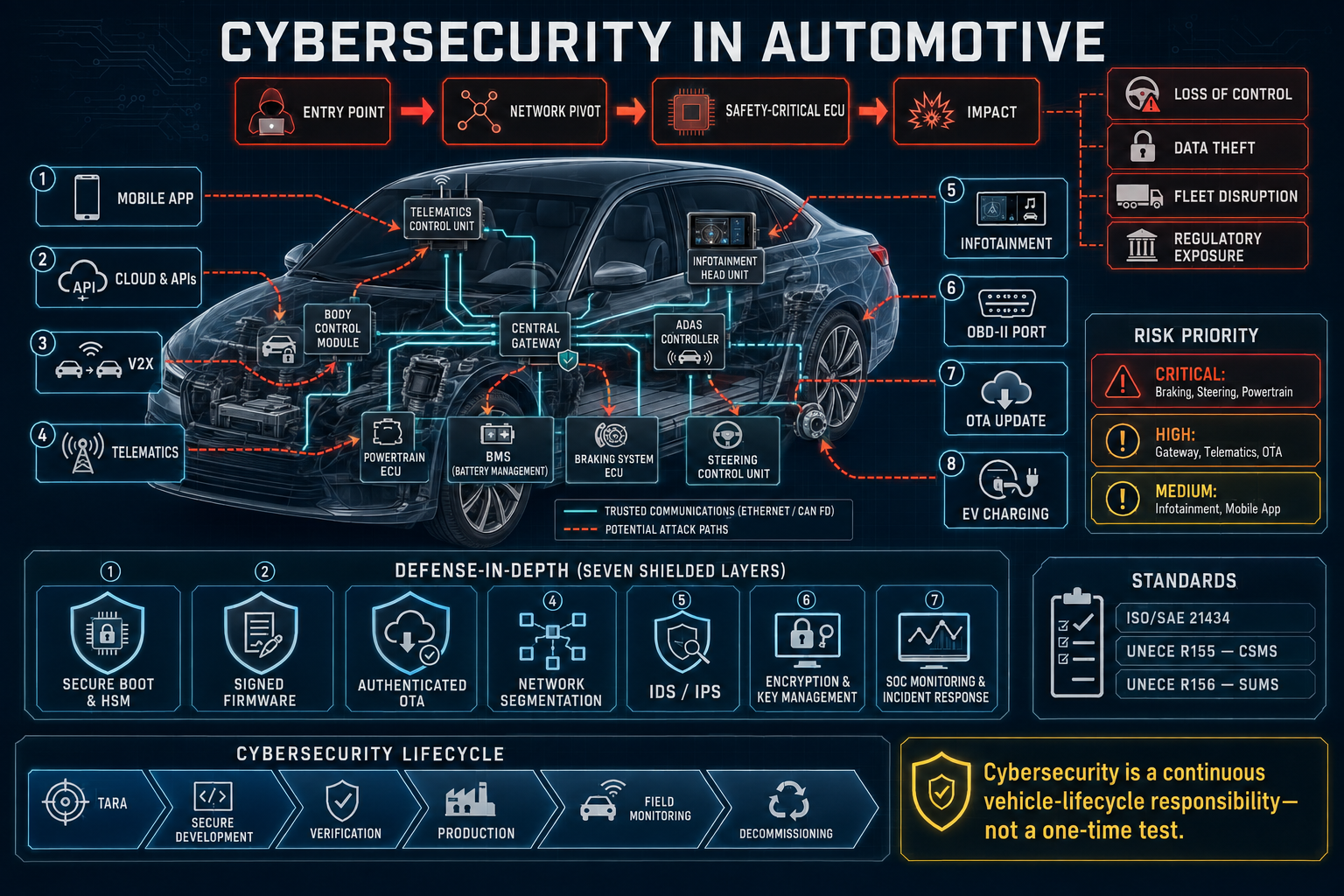
The central message of the accompanying infographic is defence in depth across the complete vehicle lifecycle. No single measure—encryption, a firewall, secure boot or a penetration test—is sufficient on its own. Effective protection requires:
- an accountable cybersecurity organization;
- risk-based product development;
- secure vehicle and backend architecture;
- controlled suppliers and software components;
- secure manufacturing, diagnostics and software updates;
- independent verification and validation; and
- field monitoring, incident response and continuous improvement.
ISO/SAE 21434 provides a lifecycle engineering framework. UN Regulation No. 155 requires an approved Cyber Security Management System (CSMS) and vehicle-type evidence where the Regulation has been adopted and applies. UN Regulation No. 156 addresses Software Update Management Systems (SUMS) and vehicle software-update requirements. ISO 24089 supports the engineering of software updates. These instruments complement one another, but they are not interchangeable.
For Indian two-wheeler programs, an especially important distinction is that the published scope of UN R155/R156 does not automatically extend to L-category motorcycles. Nevertheless, connected motorcycles remain exposed to real cyber risks, and global OEM processes, export-market requirements, customer protection, product liability, privacy obligations and future Indian rulemaking make ISO/SAE 21434-style engineering highly relevant.
1. Why automotive cybersecurity is different from ordinary IT security
Traditional IT security usually prioritizes confidentiality, integrity and availability of information. A vehicle must protect these properties too, but its risk assessment must also consider physical behaviour and road-user safety.
| Characteristic | Conventional IT system | Road vehicle |
|---|---|---|
| Main consequence | Data loss, fraud or service outage | Can additionally cause unintended vehicle behaviour and physical harm |
| Product life | Often refreshed in a few years | Vehicle may remain in service for 10–20 years or longer |
| Update access | Usually continuously connected | May have limited bandwidth, workshop-only flashing or no practical field-update path |
| Computing margin | Often comparatively high | Many ECUs have constrained memory, processing and power |
| Safety response | Shut down or isolate service | Must consider controllability and a safe/minimal-risk condition |
| Supply chain | Software and cloud vendors | OEM, Tier 1/2 suppliers, chipset vendors, telecom, cloud, dealers, tools and aftermarket devices |
| Evidence | Enterprise controls and audits | Product-level traceability, type-approval evidence, configuration and vehicle population mapping |
Cybersecurity and functional safety are complementary:
- Functional safety (ISO 26262) principally addresses hazards caused by malfunctioning E/E behaviour.
- Cybersecurity engineering (ISO/SAE 21434) addresses risks arising from deliberate malicious actions affecting vehicle E/E systems.
- SOTIF (ISO 21448) addresses hazards caused by functional insufficiencies or foreseeable misuse when the system may not be malfunctioning.
One event can cross all three domains. For example, spoofed sensor data is a cybersecurity cause, may expose a performance limitation relevant to SOTIF, and can lead to a safety hazard requiring ISO 26262 coordination.
2. Eight major automotive attack surfaces
An attack surface is any interface, component, process or relationship through which an attacker might reach a vehicle asset. Risk depends not only on the number of interfaces, but on the trust boundaries and privileges behind them.
| No. | Attack surface | Typical entry method | Assets at risk | Possible outcome | Indicative priority |
|---|---|---|---|---|---|
| 1 | OEM cloud and backend APIs | Stolen credentials, insecure API, exposed service, cloud misconfiguration | Fleet commands, vehicle identity, customer data, update packages | Mass compromise, privacy breach, unauthorized remote action | Critical where backend can command many vehicles |
| 2 | Mobile application and user account | Credential stuffing, weak session control, malicious app, insecure phone storage | Digital key, location, user profile, remote functions | Vehicle theft, tracking, account takeover | High |
| 3 | Telematics, cellular and V2X | Protocol weakness, exposed service, rogue base station, certificate misuse | TCU, gateway, remote services | Remote foothold, false messages, denial of service | High to critical |
| 4 | Bluetooth, Wi-Fi, USB and infotainment | Malformed media/file, vulnerable wireless stack, untrusted paired device | Head unit, contacts, gateway path | Code execution, data theft, pivot to other networks | Medium to high |
| 5 | Diagnostics and workshop tools | Stolen tool, leaked seed-key logic, unauthorized flashing, weak dealer identity | ECU coding, calibration, immobilizer, DTCs | Unsafe configuration, theft, emissions/safety tampering | High |
| 6 | Keyless entry and short-range interfaces | Relay/replay, RF jamming, cloned credential, NFC/BLE weakness | Access and immobilization | Theft, unauthorized start, denial of access | High for theft; safety impact varies |
| 7 | In-vehicle networks, gateways and ECUs | CAN injection, compromised node, debug-port access, message replay | Powertrain, brake, battery, cluster and body functions | Unauthorized commands, false tell-tales, loss of function | Critical if safety domain is reachable |
| 8 | OTA, software supply chain and manufacturing | Compromised signing system, dependency vulnerability, insider action, malicious build or diagnostic station | Firmware, keys, configuration, complete fleet | Persistent or fleet-wide compromise | Critical |
Important interpretation
Wireless connectivity is not the only risk. A vehicle without cellular OTA may still be attacked through diagnostics, a compromised workshop laptop, USB, Bluetooth, aftermarket accessories, manufacturing equipment or physical ECU access. Conversely, the existence of an interface does not automatically make risk unacceptable; secure architecture and restricted privilege can break the attack path.
3. How an automotive cyberattack becomes a safety event
A credible assessment should show the complete chain rather than using vague statements such as “the vehicle can be hacked.” A representative remote attack path is:
- attacker compromises a user account or internet-facing backend service;
- attacker obtains access to a remote vehicle function or the telematics channel;
- a weakness in authorization, protocol validation or the telematics unit enables code execution or command misuse;
- insufficient gateway separation permits movement toward a control network;
- a forged or replayed message reaches a safety-relevant ECU;
- the ECU accepts the command because authenticity, freshness, state validation or plausibility checks are inadequate; and
- vehicle behaviour, tell-tales or availability changes in a way that creates a damage scenario.
Every arrow is a control opportunity. Multi-factor account protection, least-privilege APIs, mutual authentication, hardened telematics, network segmentation, gateway allowlists, authenticated messages, freshness counters, secure boot, runtime monitoring and safe-state logic can collectively make the complete path impracticable.
The highest-risk characteristic is often not a dramatic individual exploit, but scalability. A backend or signing-system compromise may expose an entire fleet, while a physical attack that requires vehicle disassembly may affect only one vehicle at a time. Scale should therefore influence risk treatment, incident escalation and validation depth.
4. Threat Analysis and Risk Assessment (TARA)
TARA translates an architecture into prioritized cybersecurity work. It should begin during concept development and be updated whenever the architecture, interface, supplier, software version, diagnostic function or threat environment changes.
Practical TARA sequence
- Define the item and boundaries: vehicle functions, ECUs, backend, mobile app, diagnostic and update infrastructure, external systems and lifecycle assumptions.
- Identify assets: safety functions, executable code, cryptographic keys, calibration, vehicle identity, personal data, diagnostic authority and regulatory configuration.
- Define damage scenarios: what harm can result if confidentiality, integrity or availability is lost?
- Define threat scenarios: how could a malicious actor cause that damage?
- Construct attack paths: identify the interfaces, trust boundaries, prerequisites and sequence of actions.
- Estimate attack feasibility: consider expertise, knowledge, equipment, opportunity/window of access and time, using the organization’s approved method.
- Assess impact: evaluate safety, financial, operational and privacy consequences; add legal/reputational factors where the corporate method requires them.
- Determine risk and treatment: avoid, reduce, share/transfer where legitimate, or accept with documented authority and rationale.
- Derive cybersecurity goals and requirements: allocate controls to vehicle, ECU, backend, app, infrastructure and organizational processes.
- Verify residual risk: test controls, close findings and preserve traceable evidence.
Illustrative connected-motorcycle risk register
This example is instructional; actual ratings require program-specific architecture and evidence.
| Scenario | Potential impact | Likely assessment | Preferred treatment |
|---|---|---|---|
| Unauthorized powertrain firmware installed through diagnostics | Torque behaviour, emissions/non-compliance, engine damage | Critical/High depending on access and safeguards | Signed firmware, secure boot, authenticated diagnostics, role-controlled tool, calibration integrity check |
| Compromised connected service issues unauthorized immobilize command while riding | Loss of propulsion and rider stability | Critical | Prohibit unsafe remote actuation states, strong authorization, gateway policy, vehicle-state interlock and fail-safe logic |
| Keyless relay attack | Vehicle theft and customer loss | High | Distance-bounding/secure ranging where feasible, motion timeout, UWB or equivalent robust design, user alert and theft monitoring |
| Location history exposed by mobile app/backend | Privacy, stalking and reputational harm | High | Data minimization, consent/notice, strong account security, encryption, restricted retention and audited access |
| CAN denial of service causes loss of instrument information | Operational and possible safety impact | Medium to High | Bus-load protection, gateway filtering, fault containment, watchdog, degraded display strategy and event logging |
| Malicious accessory connected to diagnostic or accessory port | ECU/network manipulation | High | Restricted port exposure, authenticated services, segmentation, rate limits and accessory requirements |
TARA quality checks
A good TARA is not a spreadsheet created once for an audit. It should answer:
- Is every external interface represented in the item definition and architecture?
- Are safety-critical assets and personal-data assets both included?
- Do threat scenarios describe an attacker, action and affected property clearly?
- Are attack paths technically plausible and linked to architecture?
- Are assumptions—physical access, vehicle state, connectivity, credentials—recorded?
- Does every unacceptable risk produce a requirement and verification method?
- Are supplier responsibilities contractually allocated?
- Is residual-risk acceptance signed by an authorized role?
- Can the OEM identify the affected ECU software versions and vehicle population when a vulnerability emerges?
5. Seven-layer defence-in-depth model
Layer 1 — Governance and CSMS
Define policy, executive accountability, competent roles, escalation, independent review, cybersecurity culture, records, audits and lifecycle processes. Cybersecurity must be integrated with program management, quality, functional safety, homologation, IT security, legal/privacy, procurement, service and crisis management.
Layer 2 — Secure system architecture
Minimize exposed services; separate infotainment, telematics, diagnostics and safety domains; enforce gateway rules; apply least privilege; define trust boundaries; restrict debug paths; and design safe degraded behaviour. Architecture is the most effective place to prevent one compromised component from controlling the whole vehicle.
Layer 3 — ECU and software trust
Use hardware roots of trust where justified, secure boot, authenticated code, protected key storage, memory protection, hardened operating systems, disabled production debug, secure coding, dependency control and rollback protection. Control must continue through manufacturing and service replacement.
Layer 4 — Secure communication and identity
Authenticate external connections and sensitive commands, protect confidentiality where necessary, manage freshness/replay resistance, validate message plausibility and manage certificates and keys throughout their lifecycle. Classic CAN was designed primarily for real-time communication, not native sender authentication; merely “encrypting CAN” is neither universally practical nor a complete architecture.
Layer 5 — Secure diagnostics and updates
Authorize diagnostic users and tools, separate read and programming privileges, sign update packages, verify compatibility, maintain software identities, control downgrade/rollback, protect update servers, confirm adequate power and recover safely after interruption. Workshop flashing is still a software update even when OTA is not used.
Layer 6 — Backend, mobile and operational security
Apply secure API design, identity and access management, secrets protection, cloud configuration control, rate limiting, fraud detection, logging, privacy-by-design, mobile application hardening, build-pipeline security and signing-key protection. Vehicle security cannot exceed the security of the backend that controls it.
Layer 7 — Verification, monitoring and response
Perform architecture review, static/dynamic analysis, fuzzing, penetration testing, interface abuse testing, vulnerability scanning, supplier evidence review and scenario-based validation. In the field, operate threat monitoring, a vulnerability disclosure channel, incident triage, fleet impact analysis, containment, corrective update/service action and lessons-learned feedback.
NHTSA’s 2022 guidance similarly emphasizes a risk-based, layered approach, hardware/software inventory, independent testing, monitoring and remediation, documentation, supplier expectations and secure internal/external interfaces.
6. Cybersecurity across the product-development lifecycle
| Phase | Main engineering activity | Minimum evidence / gate output |
|---|---|---|
| Concept and business planning | Determine connectivity, remote functions, data use, update strategy, markets and regulatory scope | Item definition, applicability matrix, initial asset list, cybersecurity plan and budget |
| System design | Define architecture, trust boundaries and cybersecurity goals | TARA, cybersecurity concept, interface controls, functional-safety coordination |
| HW/SW development | Implement and review cybersecurity requirements | Detailed requirements, design review, code-analysis results, component tests and vulnerability records |
| Supplier sourcing | Allocate roles and evidence | Cybersecurity interface agreement, supplier capability assessment, delivery/incident obligations |
| Integration and validation | Prove that controls work and attack paths are mitigated | Integration tests, fuzzing, penetration testing, residual-risk decisions and cybersecurity case/argument |
| Industrialization and production | Protect keys, software and configuration in factories | Secure provisioning, end-of-line controls, traceability, access logs and production-audit evidence |
| Homologation / release | Demonstrate organizational and vehicle-type compliance where applicable | CSMS/SUMS certificates, type-level evidence, software identification and approval records |
| Operations and service | Monitor threats, vulnerabilities, field versions and incidents | SOC/monitoring process, disclosure channel, incident response, update/service campaign evidence |
| End of support / decommissioning | Retire services and credentials safely | Support-period decision, customer communication, backend/key decommissioning and data deletion plan |
Gate-review questions
- Concept gate: Is the remote feature necessary, and can its privilege be reduced?
- Design gate: Can compromise of a public-facing interface reach a safety domain?
- Supplier gate: Who owns vulnerability monitoring and patch delivery after SOP and EOP?
- Validation gate: Has testing challenged the real trust boundaries, not only nominal functions?
- Release gate: Are all unacceptable risks closed or formally accepted with valid evidence?
- Post-production gate: Can affected vehicles and software versions be identified quickly?
7. Standards and regulation map
| Instrument | Nature | Primary purpose | Practical relationship |
|---|---|---|---|
| UN Regulation No. 155 | Type-approval regulation when adopted by a jurisdiction | Organizational CSMS certificate plus vehicle-type cybersecurity evidence | Defines regulatory outcome; does not prescribe one fixed technical solution |
| UN Regulation No. 156 | Type-approval regulation when adopted | SUMS and controlled vehicle software updates, including update traceability and safe/secure execution | Links updates to configuration and approval-relevant software management |
| ISO/SAE 21434:2021 | Voluntary international engineering standard unless contract/law makes it required | Cybersecurity risk management over the E/E lifecycle | Common implementation framework supporting R155 readiness; not itself an R155 approval |
| ISO 24089:2023 | Voluntary international engineering standard | Organizational and project-level software-update engineering | Supports SUMS and secure, traceable update processes; not itself an R156 approval |
| ISO 26262 | Functional-safety standard | Risk from malfunctioning E/E behaviour | Coordinate cybersecurity controls and safety mechanisms; neither replaces the other |
| ISO 21448 | SOTIF standard | Hazards from functional insufficiency or foreseeable misuse | Relevant where sensor spoofing or perception limitations affect intended functionality |
| ISO/IEC 27001 | Information-security management-system standard | Enterprise/back-office information security | Useful for cloud, enterprise and operational controls, but does not replace product cybersecurity engineering |
| NIST CSF 2.0 | Voluntary organizational framework | Govern, Identify, Protect, Detect, Respond and Recover | Useful umbrella for corporate cybersecurity and backend operations |
Scope warning for motorcycles
The published UN R155 scope covers M and N vehicle categories and certain O-category trailers; UN R156 covers specified categories that permit software updates. L-category two- and three-wheelers are not automatically brought into these Regulations merely because they have connectivity. Therefore:
- do not claim a motorcycle has an R155/R156 obligation without confirming the applicable national adoption and vehicle category;
- do not infer that motorcycles have no cybersecurity responsibility;
- apply corporate cybersecurity processes proportionate to the product risk; and
- track future Indian and export-market proposals separately from final notified requirements.
Indian regulatory position — how AutoPDP should report it
India’s vehicle type-approval obligation arises only after an applicable requirement is formally notified under the Indian legal/CMVR framework, with defined scope and implementation dates. At the review date of this article, AutoPDP should not present third-party claims about “AIS-189/AIS-190” numbers or an October 2027 mandate as settled law unless the corresponding official AISC/MoRTH text and GSR notification are verified.
Use a three-stage status label in the AutoPDP regulatory tracker:
| Status | Meaning | Website wording |
|---|---|---|
| Emerging / industry discussion | Direction is visible, but no controlled official draft verified | “Monitor; not a confirmed CMVR obligation” |
| Official draft / consultation | MoRTH/AISC controlled draft is available | Show draft number, publication date, comments deadline, scope and proposed dates |
| Final notified | Gazette/CMVR amendment establishes legal requirement | Show GSR number, effective dates for new/existing types, categories and transition provisions |
Connected-vehicle services also process personal data such as identity, location, driving behaviour and device information. Indian programs should therefore coordinate vehicle cybersecurity with the Digital Personal Data Protection framework, consent/notice, purpose limitation, access control, retention, breach response and third-party processing obligations.
8. Special engineering considerations for motorcycles and electric two-wheelers
Motorcycles may contain fewer ECUs than premium passenger cars, but the rider has less physical protection and can be highly sensitive to abrupt torque loss, false instrument warnings or unexpected braking behaviour. Key areas include:
- ride-by-wire throttle and engine-control integrity;
- ABS, traction control, IMU and wheel-speed signal integrity;
- connected instrument cluster and smartphone pairing;
- telematics and stolen-vehicle tracking;
- keyless ignition and immobilizer;
- ECU flashing, tuning tools and aftermarket accessories;
- emergency-call or crash-detection functions;
- EV battery-management, charger communication and thermal-control logic;
- user account, location and journey-history privacy; and
- secure service diagnostics across the dealer network.
Motorcycle design principle
Remote convenience functions must never have unnecessary direct authority over riding-critical functions. If a remote immobilization feature exists, its state logic should prevent unsafe activation while the motorcycle is moving. Gateway and ECU plausibility controls should ensure that a compromised cluster, app or telematics unit cannot issue unrestricted powertrain or brake commands.
9. Homologation and audit evidence expected from a mature OEM
A regulator or technical service may review both the organization and the vehicle type. A practical evidence library should include:
- cybersecurity policy, governance chart, competence and audit records;
- CSMS and SUMS process descriptions where applicable;
- vehicle item definition, architecture and trust-boundary diagrams;
- asset catalogue, TARA, treatment decisions and residual-risk approvals;
- cybersecurity goals, requirements and bidirectional traceability;
- cybersecurity interface agreements with suppliers;
- hardware/software inventory and vehicle/ECU version mapping;
- secure-development and code-quality evidence;
- secure-boot, key-management, diagnostics and communication design evidence;
- vulnerability analysis, fuzzing, penetration and validation reports;
- update package, compatibility, rollback and failure-recovery evidence;
- software identification and approval-impact assessment;
- manufacturing provisioning and production access-control records;
- field monitoring, disclosure, incident response and campaign processes; and
- cybersecurity case or structured release argument showing why residual risk is acceptable.
Integration with change control and COP/WVSCoP
Cybersecurity configuration should be linked to the approved bill of materials, software version, calibration and vehicle identification. Changes to a TCU, gateway, ECU firmware, cryptographic library, mobile app, cloud API, certificate service, diagnostic access or update method should trigger an impact assessment. The assessment must determine whether the change affects:
- cybersecurity goals or attack paths;
- functional safety or SOTIF assumptions;
- emissions, braking, lighting, tell-tales or other approval-relevant functions;
- the software identification record;
- existing type approval or extension requirements;
- production conformity; and
- vehicles already operating in the field.
10. Testing strategy
Cybersecurity validation should combine methods because each reveals different weaknesses.
| Test method | What it finds | Common limitation if used alone |
|---|---|---|
| Requirements and architecture review | Missing trust boundaries, excessive privilege, unsafe dependencies | Depends on design accuracy and reviewer competence |
| Static analysis and code review | Coding defects, insecure APIs and secret handling | May not expose runtime or integration behaviour |
| Software composition analysis | Known vulnerable third-party/open-source components | Does not find unknown vulnerabilities or unsafe application logic |
| Fuzzing | Parser, protocol and robustness faults | Coverage may be incomplete; needs realistic interfaces and monitoring |
| Penetration testing | Exploitable attack chains and control bypasses | A time-limited sample, not proof of absence of vulnerabilities |
| Hardware/physical testing | Debug, key extraction, bus access and tamper weaknesses | May focus on one ECU/sample and miss fleet-scale backend risks |
| Backend/API/mobile testing | Account, authorization, API and cloud weaknesses | Must be coordinated with vehicle-state and fleet-command consequences |
| Update interruption/rollback testing | Bricking, downgrade, power-loss and recovery failures | Needs all real update variants and vehicle configurations |
| Scenario-based safety validation | Vehicle response after a successful attack or detected anomaly | Requires close cybersecurity–functional-safety integration |
Release criteria should cover both preventive control performance and safe behaviour when prevention fails.
11. Field monitoring and incident response
Cybersecurity does not end at SOP or type approval. New vulnerabilities can emerge in operating systems, open-source libraries, chipsets, telecom protocols, cloud platforms and supplier tools after vehicle launch.
A mature field process should:
- collect authorized, privacy-conscious security telemetry and diagnostic evidence;
- receive reports through a vulnerability disclosure channel;
- correlate external intelligence with the software/component inventory;
- identify affected vehicle types, ECUs, software versions and VIN populations;
- assess exploitability, safety, compliance, privacy and fleet scalability;
- contain backend access or risky features where appropriate;
- create, verify and authorize an OTA update, workshop update or component/service action;
- notify authorities and customers where legally required;
- measure campaign completion and residual exposure; and
- feed lessons learned into new programs and supplier requirements.
Not every cyber vulnerability automatically requires a physical recall. The response may be a backend correction, credential revocation, OTA update, dealer reflash, service campaign, user instruction, feature restriction or recall. The decision must be risk-based, legally reviewed, documented and fast enough to protect road users.
12. Common misconceptions
| Misconception | Correct analysis |
|---|---|
| “The vehicle is secure because the external link is encrypted.” | Encryption protects only selected properties of one link. Endpoint compromise, weak authorization, key theft and unsafe internal architecture may remain. |
| “Passing a penetration test proves cybersecurity.” | It proves only that the tested team did not find an exploitable issue within the defined scope and time. Lifecycle monitoring remains essential. |
| “ISO/SAE 21434 certification equals UN R155 approval.” | ISO/SAE 21434 can support engineering evidence; R155 approval requires the applicable authority’s CSMS and vehicle-type assessment. |
| “The supplier is responsible for ECU security.” | Suppliers own allocated work, but the vehicle manufacturer must manage integrated vehicle and supply-chain risk. |
| “No OTA means no software-update risk.” | Workshop, factory, replacement ECU and diagnostic flashing are also update paths. |
| “Cybersecurity is an IT department task.” | It is a cross-functional product-safety and lifecycle responsibility. |
| “Motorcycles are outside R155, so no action is needed.” | Regulatory scope and engineering risk are different questions. Connected two-wheelers still need proportionate protection. |
13. Recommended OEM implementation roadmap
First 30 days — establish scope and governance
- appoint accountable product-cybersecurity leadership and cross-functional RACI;
- create a market/category applicability register;
- select one pilot vehicle program;
- map the vehicle, backend, mobile app, update, manufacturing and service ecosystem;
- catalogue ECUs, software, external interfaces and suppliers;
- assess gaps against ISO/SAE 21434, R155/R156 where applicable and ISO 24089; and
- freeze unsafe new remote-feature releases until high-risk trust boundaries are reviewed.
Days 31–60 — perform engineering risk analysis
- complete the pilot item definition and TARA;
- identify fleet-scale attack paths;
- derive cybersecurity goals and technical requirements;
- issue supplier cybersecurity interface agreements;
- establish software/component inventory and vulnerability-monitoring ownership;
- define diagnostic roles, software signing and key lifecycle; and
- align TARA with HARA, SOTIF and privacy impact assessment.
Days 61–90 — prove readiness
- conduct independent architecture review and targeted penetration/fuzz testing;
- test update interruption, rollback and safe-state behaviour;
- exercise an incident-response tabletop scenario;
- demonstrate affected-population identification from a sample vulnerability;
- close or formally accept residual risk;
- build the auditable evidence index; and
- establish management KPIs and periodic review.
Six- to twelve-month maturity target
- institutionalize CSMS/SUMS across programs;
- integrate cybersecurity gates into APQP/product development and change control;
- automate SBOM/software-version correlation where practical;
- establish continuous supplier and field-vulnerability monitoring;
- conduct regular crisis simulations and independent audits; and
- maintain regulatory watch for each target market and vehicle category.
14. Suggested management dashboard KPIs
| KPI | Why it matters |
|---|---|
| Percentage of vehicle programs with approved item definition and TARA | Measures lifecycle deployment, not only policy creation |
| Open critical/high residual risks by program and gate | Highlights release risk |
| Percentage of safety-relevant ECUs with verified secure boot/authenticated flashing | Measures key preventive coverage |
| Hardware/software inventory and SBOM coverage | Enables fleet impact analysis |
| Mean time to triage and remediate critical vulnerabilities | Measures field responsiveness |
| Percentage of suppliers with accepted cybersecurity evidence | Exposes supply-chain readiness |
| Cybersecurity requirements verified before release | Confirms traceability and completion |
| Update/campaign completion rate for affected vehicles | Measures remaining field exposure |
| Unauthorized diagnostic attempts and anomalous fleet events | Supports detection and investigation |
| CSMS/SUMS audit findings overdue | Indicates governance weakness |
15. AutoPDP conclusion
Automotive cybersecurity must be treated as an engineering and management discipline, not a late-stage test. The correct objective is not to promise an “unhackable vehicle.” It is to identify valuable assets, understand credible attack paths, reduce risk through layered architecture, detect and contain attacks, maintain safe vehicle behaviour and respond throughout the field life of the product.
For homologation teams, the most important practice is disciplined separation of four questions:
- What is the technical risk? — answered through item definition, TARA, design and validation.
- What process standard is being applied? — for example ISO/SAE 21434 or ISO 24089.
- What regulation legally applies? — determined by jurisdiction, adoption, category, type and implementation date.
- What approval evidence is required? — determined by the approval authority/technical service and the applicable regulation.
This separation prevents two common errors: treating voluntary engineering standards as automatically mandatory law, and treating the absence of a current category-specific regulation as permission to ignore a foreseeable safety or privacy risk.
Official reference links
- ISO/SAE 21434:2021 — Road vehicles — Cybersecurity engineering
- ISO 24089:2023 — Road vehicles — Software update engineering
- UN Regulation No. 155 — Cyber security and cyber security management system
- UN Regulation No. 156 — Software update and software update management system
- NHTSA — Cybersecurity Best Practices for the Safety of Modern Vehicles, Updated 2022
- NIST Cybersecurity Framework 2.0