From Idea to Customer Satisfaction
Chapter 15 · Automotive Product Development
Use the infographic for the process overview, then follow the chapter sections for definitions, activities, deliverables, gate evidence, and implementation detail.
Chapter infographic
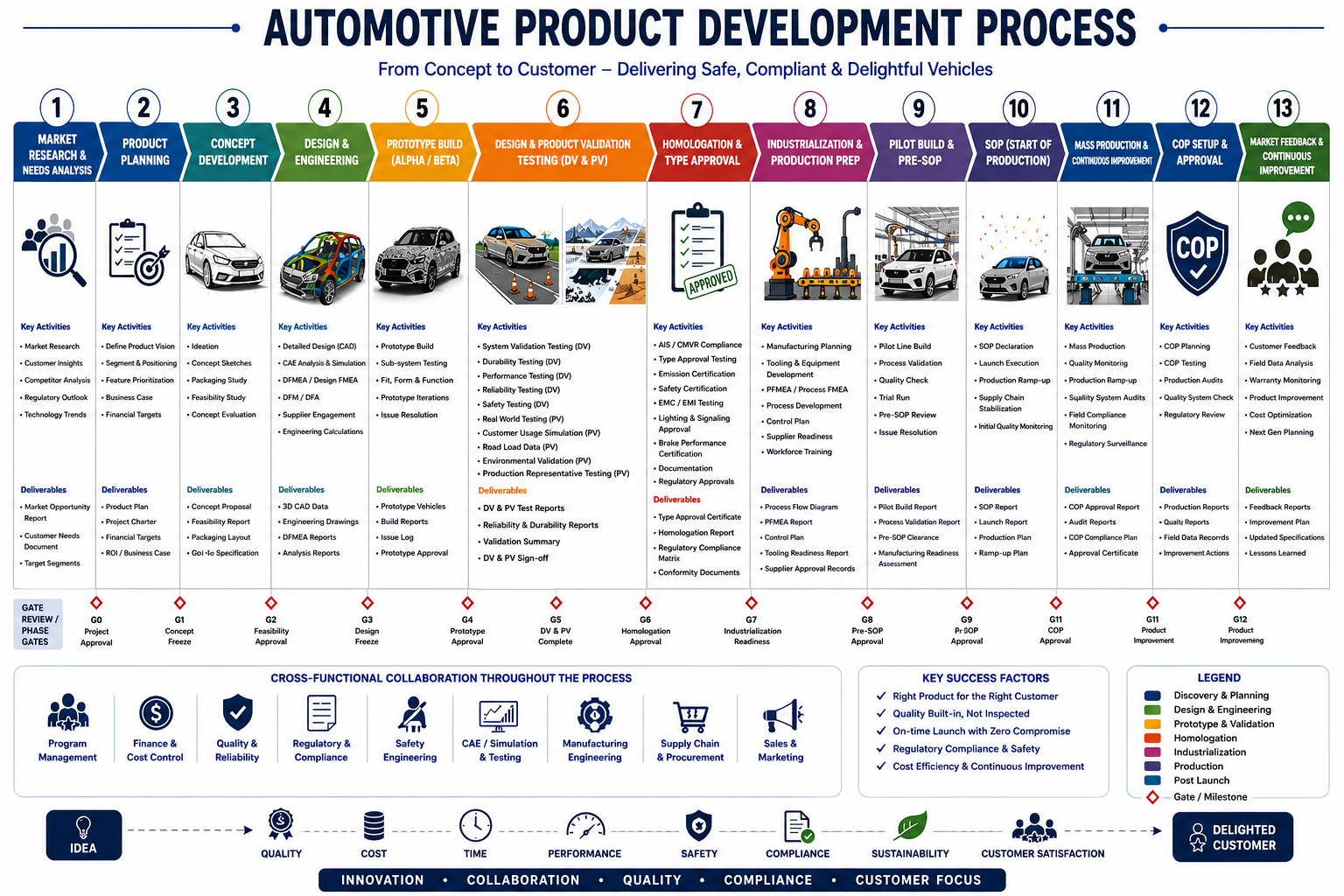
Automotive Product Development Process
From Idea to Customer Satisfaction – Building Safe, Reliable, Compliant and Delightful Vehicles
Introduction
Automotive Product Development is a complete journey that transforms an initial idea into a finished vehicle delivered to customers. It is not only an engineering activity; it is a business, manufacturing, quality, regulatory, supplier, service and customer-focused process.
A successful vehicle is not created by one department alone. It is the result of strong coordination between product planning, design, engineering, validation, manufacturing, homologation, quality, suppliers, service, sales and customer support teams.
The complete Automotive Product Development Process ensures that the final product is:
- Technically feasible
- Safe for customers
- Compliant with regulations
- Reliable in real-world usage
- Manufacturable at required volume
- Cost-effective for business
- Easy to service and maintain
- Accepted by customers in the market
This final chapter summarizes the complete process and explains how all phases work together to deliver a successful vehicle.
1. Complete Automotive Product Development Journey
The Automotive Product Development Process starts with a market need and ends with customer satisfaction and continuous improvement.
The complete journey can be summarized as:
Idea → Market Research → Product Planning → Concept Development → Vehicle Architecture → Detailed Design → Prototype Development → Validation → Homologation → Industrialization → Pilot Build → SOP → Mass Production → COP → Market Feedback → Continuous Improvement
Each phase adds maturity to the product and reduces risk before the vehicle reaches the customer.
2. Summary of All Major Phases
3. Importance of Phase-Gate Reviews
Phase-gate reviews are important control points in the development process. They ensure that the project does not move to the next stage until key requirements are fulfilled.
Each gate review checks:
- Technical readiness
- Quality readiness
- Cost status
- Risk level
- Supplier readiness
- Manufacturing readiness
- Regulatory compliance
- Documentation completion
- Management approval
A strong gate review process prevents late changes, cost overruns, validation failures and launch delays.
4. Cross-Functional Collaboration
Automotive product development requires strong teamwork across departments.
The key functions involved are:
- Program Management
- Product Planning
- Design Engineering
- CAE and Simulation
- Testing and Validation
- Homologation and Regulatory Affairs
- Manufacturing Engineering
- Production
- Quality Assurance
- Supplier Quality
- Procurement and Supply Chain
- Service and Warranty
- Sales and Marketing
- Finance and Cost Control
- Management
Every function has a specific role, but the final success depends on how effectively these teams work together.
For example, design engineering may create the product, but manufacturing ensures it can be produced, homologation ensures it can be legally sold, quality ensures it meets standards, and service ensures customers can maintain it easily.
5. Role of Quality Throughout the Process
Quality should not be treated as a final inspection activity. It must be built into every phase of product development.
Quality starts from:
- Correct understanding of customer requirements
- Robust design
- Proper DFMEA and PFMEA
- Strong supplier development
- Accurate validation testing
- Controlled production process
- Effective COP system
- Customer feedback analysis
The principle should be:
Quality must be built in, not inspected in.
When quality is considered from the beginning, the final product becomes more reliable, safer and more acceptable to customers.
6. Role of Homologation and Regulatory Compliance
Homologation and regulatory compliance are critical parts of the development process. A vehicle cannot be sold legally unless it complies with applicable regulations.
For India, key regulatory areas may include:
- CMVR requirements
- AIS standards
- Emission regulations
- Safety regulations
- Braking requirements
- Lighting and signalling requirements
- Noise requirements
- EMC requirements
- OBD requirements
- EV battery and high-voltage safety requirements
- COP and WVSCoP requirements
Testing and certification agencies such as ARAI, ICAT, CIRT, GARC and other approved agencies play an important role in Type Approval and compliance verification.
Homologation should not start at the end of development. It must begin from the planning and concept stage itself.
7. Importance of Validation
Validation proves that the vehicle works as intended.
There are two important dimensions:
Design Validation
Design Validation confirms that the engineering design meets technical requirements.
It includes:
- Functional testing
- Performance testing
- Durability testing
- Safety testing
- Environmental testing
- NVH testing
- Electrical and electronics testing
- Software validation
Product Validation
Product Validation confirms that the vehicle performs well in real-world customer usage conditions.
It includes:
- Road testing
- Customer usage simulation
- High mileage testing
- Hot and cold weather testing
- Dust, water and altitude testing
- Reliability testing
- Field durability testing
Without proper validation, field failures, warranty claims and customer dissatisfaction may increase after launch.
8. Manufacturing Readiness and SOP Success
A product can be successful only if it can be manufactured repeatedly with stable quality.
Industrialization, Pilot Build and SOP ensure that the manufacturing system is ready.
Important manufacturing readiness points include:
- Process flow defined
- Plant layout ready
- Tools and fixtures validated
- Equipment installed and qualified
- Control Plan prepared
- PFMEA completed
- Operators trained
- Suppliers ready
- Logistics flow stable
- EOL systems validated
- Quality gates active
- ERP / MES systems ready
SOP should start only after all critical issues are closed and management approval is received.
9. Mass Production and Continuous Improvement
After SOP, the focus moves to stable mass production.
Mass production success depends on:
- Daily production control
- Material availability
- Supplier quality
- In-process quality checks
- EOL testing
- Dispatch quality
- KPI monitoring
- Corrective action
- Warranty review
- Customer feedback
Continuous improvement must continue throughout the product lifecycle.
Typical improvement areas include:
- Quality improvement
- Cost reduction
- Productivity improvement
- Warranty reduction
- Supplier improvement
- Service improvement
- Customer experience improvement
- Process optimization
A good organization continuously improves even after product launch.
10. COP and WVSCoP: Maintaining Compliance After Production Starts
Type Approval confirms that the tested vehicle complies with regulations. COP ensures that production vehicles continue to conform to the approved type.
COP – Conformity of Production ensures ongoing conformity of production vehicles with the approved Type Approval.
WVSCoP – Whole Vehicle Safety Conformity of Production ensures that production vehicles continue to meet whole-vehicle safety requirements.
COP requires:
- Production control
- Traceability
- Periodic testing
- Internal audits
- Corrective actions
- Change control
- Supplier control
- Document control
- Record retention
- Renewal before expiry
COP is not a one-time activity. It is a continuous responsibility of the manufacturer.
11. Market Feedback: Closing the Development Loop
The product development process does not end when the vehicle is launched. Real learning starts when customers use the product in actual conditions.
Market feedback comes from:
- Customers
- Dealers
- Service network
- Warranty system
- Field data
- Telematics
- Social media
- Regulatory feedback
- Supplier feedback
- Competitor benchmarking
This feedback helps identify:
- Product failures
- Repeat complaints
- Service difficulties
- Warranty trends
- Quality gaps
- Customer expectations
- Future product opportunities
The ideal feedback loop is:
Listen → Understand → Act → Improve → Delight Customers
This loop helps improve current products and also provides valuable learning for future projects.
12. Common Challenges in Automotive Product Development
Automotive product development faces many challenges.
Common challenges include:
- Changing regulations
- Aggressive timelines
- Cost pressure
- Supplier delays
- Validation failures
- Late design changes
- Homologation delays
- Tooling issues
- Production quality problems
- Software and calibration issues
- Market requirement changes
- Warranty concerns after launch
These challenges can be managed through strong planning, early risk identification, cross-functional teamwork and disciplined project governance.
13. Key Success Factors
A successful Automotive Product Development Process depends on the following factors:
Clear Product Vision
The product must have a clear purpose, target customer and market positioning.
Customer-Focused Development
Customer needs should guide product decisions from the beginning.
Robust Engineering
Design must be technically strong, reliable and manufacturable.
Early Regulatory Involvement
Homologation and compliance must be considered from the concept stage.
Strong Validation
Laboratory, field and real-world testing must be properly planned and executed.
Supplier Readiness
Suppliers must be involved early and monitored closely.
Manufacturing Readiness
Production processes, tools, equipment, manpower and quality systems must be ready before SOP.
Effective Quality Control
Quality must be built into design, process and production.
Strong Change Management
All design, process, supplier and software changes must be controlled.
Continuous Improvement
Market feedback and production data must be used to improve products and processes.
14. Automotive Product Development as a Continuous Cycle
Automotive development should not be seen as a straight line. It is a continuous cycle.
Every product launch provides learning for the next product.
The cycle can be described as:
Develop → Validate → Launch → Monitor → Improve → Learn → Develop Better Next Product
This continuous learning process helps manufacturers improve product quality, reduce failures, control cost, meet regulations and increase customer satisfaction.
15. Future Direction of Automotive Product Development
The automotive industry is changing rapidly. Future product development will be influenced by:
- Electric vehicles
- Hybrid technologies
- Connected vehicles
- Software-defined vehicles
- Advanced driver assistance systems
- Cybersecurity
- Over-the-air updates
- Battery safety
- Sustainability
- Lightweight materials
- Artificial intelligence
- Digital manufacturing
- Global regulatory harmonization
Because of these changes, automotive engineers must develop strong knowledge not only in mechanical systems, but also in electronics, software, data analysis, regulations and customer experience.
16. Final Message to Engineers, Students and Automotive Professionals
Automotive Product Development is a challenging but highly rewarding field. It requires technical knowledge, practical experience, problem-solving ability and teamwork.
Every engineer and professional involved in this process contributes to customer safety, product quality and brand reputation.
A designer improves the product concept. A validation engineer proves reliability. A homologation engineer ensures legal compliance. A manufacturing engineer makes production possible. A quality engineer protects customers from defects. A service engineer supports customers after sale. A supplier contributes critical parts and technology. A program manager brings all functions together.
A successful vehicle is the result of all these contributions.
Conclusion
The Automotive Product Development Process is a structured journey from concept to customer. It combines market research, product planning, engineering design, prototype development, validation, homologation, industrialization, production, COP and market feedback into one complete system.
The final goal is not only to launch a vehicle, but to launch a vehicle that is safe, reliable, compliant, manufacturable, serviceable, cost-effective and satisfying to customers.
A strong product development process helps manufacturers reduce risk, improve quality, control cost, meet regulatory requirements and build long-term customer trust.
The most important principle is:
Customer feedback is not the end of the process; it is the beginning of the next improvement.
Final Key Takeaways
Automotive product development is a complete end-to-end process from idea to customer satisfaction.
Every phase has a clear objective, deliverables and gate review.
Cross-functional teamwork is essential for successful vehicle development.
Quality, safety, compliance, cost and customer satisfaction must be considered throughout the process.
Homologation and COP ensure legal compliance before and after production.
Market feedback closes the loop and drives continuous improvement.
A successful vehicle is not only designed well; it is validated well, manufactured well, approved legally, supported properly and improved continuously.
Closing Statement
The true success of Automotive Product Development is achieved when the customer receives a vehicle that performs reliably, operates safely, complies with regulations, provides value for money and creates pride of ownership.
That is the purpose of the complete Automotive Product Development Process:
To convert an idea into a safe, compliant, reliable and delightful vehicle for the customer.
Reference tables from the source chapter
| Phase | Main Purpose |
|---|---|
| Market Research & Needs Analysis | Understand customer needs, market opportunity and competitor position |
| Product Planning | Define product vision, business case, cost target and project roadmap |
| Concept Development | Create and select feasible vehicle concepts |
| Vehicle Architecture & System Design | Define vehicle layout, systems, interfaces and packaging |
| Detailed Design & Engineering | Convert concept into complete engineering design |
| Prototype Development | Build physical prototypes and identify early issues |
| Design & Product Validation Testing | Validate product performance, durability, reliability and real-world usage |
| Homologation & Type Approval | Obtain regulatory approval for legal sale and registration |
| Industrialization & Production Preparation | Prepare plant, process, tooling, suppliers and manpower |
| Pilot Build & Pre-SOP | Validate manufacturing process before official production |
| SOP – Start of Production | Start controlled serial production |
| Mass Production & Continuous Improvement | Produce vehicles consistently at target volume and improve continuously |
| COP Setup & Approval | Ensure production vehicles continue to match approved Type Approval |
| Market Feedback & Continuous Improvement | Capture field data and improve product, process and customer experience |
Frequently asked questions
What connects all phases of automotive development?
Controlled requirements, cross-functional ownership, evidence-based gate reviews, risk management, configuration control, and a shared focus on the customer connect the full lifecycle.
Where should quality be introduced?
Quality begins with correct requirements and continues through robust design, supplier development, validation, process control, COP, and field learning.
When is vehicle development truly complete?
A program does not end at launch. Production performance, compliance, warranty, market feedback, and continuous improvement remain active throughout the product lifecycle.
Related articles
Phase review toolkit
Why this phase matters
Lifecycle review turns separate phase outputs into one learning system centered on customer value and controlled evidence.
Inputs, outputs and gate review
- Inputs: Program results, approval history, production performance, field learning and business outcomes.
- Outputs: Lessons learned, reusable standards, capability improvements and inputs to the next product strategy.
- Gate-review summary: Confirm that technical, commercial, manufacturing, compliance and customer objectives have been compared with their original assumptions.
Chapter Checklist
- Inputs are controlled and traceable
- Outputs have an accountable owner and approval status
- Open risks include containment, due date and decision authority
- Configuration and assumptions match downstream evidence
- Compliance and change impacts are recorded