Automotive Product Development Process
Chapter 01 · Automotive Product Development
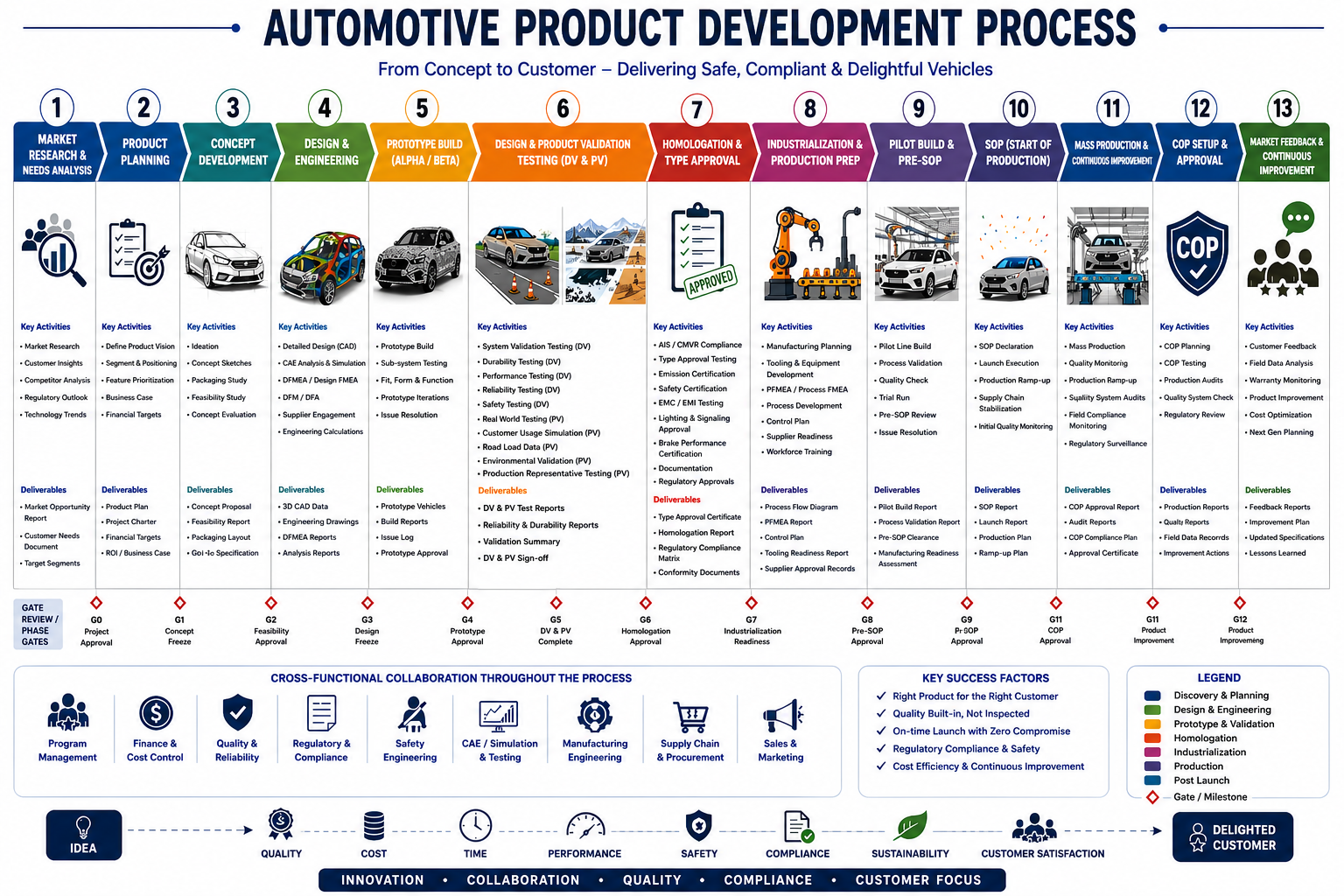
Use the infographic for the process overview, then follow the chapter sections for definitions, activities, deliverables, gate evidence, and implementation detail.
Chapter infographic
Introduction
Developing a new vehicle is one of the most complex engineering activities in the automotive industry. A modern vehicle consists of thousands of components that must work together safely, reliably, and in compliance with regulatory requirements.
From the initial concept to customer delivery, vehicle development involves multiple departments, including product planning, design, testing, manufacturing, quality, purchasing, and homologation.
This article explains the complete vehicle development process in a practical and easy-to-understand manner.
1. Market Research and Product Planning
Every vehicle development project begins with understanding customer requirements and market opportunities.
Key activities include:
- Market analysis
- Competitor benchmarking
- Customer surveys
- Cost target definition
- Sales volume forecasting
- Regulatory requirement assessment
Typical questions answered during this stage:
What type of vehicle should be developed?
What customer problem will it solve?
What should be the target price?
What features are required?
Output
- Product Concept
- Business Case
- Project Approval
2. Concept Development
Once the project is approved, engineers begin creating the vehicle concept.
Activities include:
- Vehicle architecture definition
- Packaging studies
- Preliminary styling
- Performance target setting
- Technology selection
Output
- Concept Design
- Initial Technical Specifications
- Program Feasibility Assessment
3. Vehicle Architecture and System Design
At this stage, major vehicle systems are defined.
Systems include:
- Powertrain
- Chassis
- Suspension
- Braking System
- Electrical System
- Lighting System
- Body Structure
Engineers define:
- Interfaces
- Performance targets
- Design constraints
- Regulatory requirements
Output
- System Specifications
- Vehicle Architecture Freeze
4. Detailed Design and Engineering
This phase converts concepts into actual engineering designs.
Activities
- CAD modelling
- Engineering drawings
- Material selection
- Tolerance definition
- Design calculations
Departments involved
- Design Engineering
- CAE Engineering
- Manufacturing Engineering
- Supplier Engineering
Key Deliverables
- 3D CAD Models
- Engineering Drawings
- Bill of Materials (BOM)
5. Design Validation and Analysis
Before physical prototypes are built, virtual validation is performed.
Common analyses include:
- Structural Analysis
- Fatigue Analysis
- Thermal Analysis
- Crash Simulation
- CFD Analysis
- Vibration Analysis
Benefits
- Reduced development cost
- Faster design improvements
- Early issue identification
Output
- Design Validation Report
- Design Improvement Actions
6. Prototype Development
Physical prototypes are built to verify design assumptions.
Prototype stages may include:
Alpha Prototype
Purpose
- Initial concept validation
Beta Prototype
Purpose
- Functional testing
Pre-Production Prototype
Purpose
- Manufacturing and certification readiness
Activities
- Prototype assembly
- Fit and finish evaluation
- Functional verification
7. Component Testing
Each vehicle component must be validated before vehicle-level testing begins.
Examples
Objective
Ensure individual components meet design requirements.
8. Vehicle Testing and Validation
Vehicle-level testing verifies overall performance.
Performance Testing
- Acceleration
- Maximum Speed
- Gradeability
- Fuel Economy
Safety Testing
- Braking Performance
- Stability
- Lighting Compliance
Environmental Testing
- Emissions
- Noise
- EMC
Durability Testing
- Road Load Testing
- Endurance Testing
- Reliability Validation
Output
- Vehicle Validation Report
9. Homologation and Regulatory Certification
Before commercial sale, the vehicle must comply with applicable regulations.
In India, compliance is generally demonstrated through:
- CMVR Requirements
- AIS Standards
- Emission Regulations
- Safety Regulations
Testing agencies may include:
- ARAI
- ICAT
- GARC
- CIRT
- NATRAX
Deliverable
Type Approval Certificate
Without homologation approval, a vehicle cannot be legally sold.
10. Manufacturing Preparation
Once validation is complete, production facilities are prepared.
Activities include:
- Production line setup
- Tooling installation
- Process validation
- Operator training
- Quality planning
Methods commonly used:
- APQP
- PPAP
- Control Plans
- PFMEA
Objective
Ensure consistent product quality during mass production.
11. Pilot Production
A limited number of vehicles are produced before mass production.
Purpose
- Verify manufacturing processes
- Identify assembly issues
- Confirm quality targets
Typical checks:
- Assembly quality
- Process capability
- Supplier readiness
12. Mass Production and Launch
The vehicle is officially launched in the market.
Activities include:
- Production ramp-up
- Dealer training
- Spare parts planning
- Customer support preparation
Success is measured by:
- Product quality
- Customer satisfaction
- Sales performance
13. Conformity of Production (COP)
Vehicle development does not end after launch.
Manufacturers must continuously demonstrate compliance with approved specifications.
Activities include:
- COP audits
- Production testing
- Quality reviews
- Regulatory reporting
This ensures production vehicles remain compliant throughout their lifecycle.
Common Challenges in Vehicle Development
- Changing regulations
- Aggressive timelines
- Cost pressures
- Supplier delays
- Design changes
- Validation failures
Successful vehicle development requires strong coordination between engineering, quality, manufacturing, suppliers, and regulatory teams.
Conclusion
The vehicle development process is a structured journey from idea to production. It combines engineering innovation, testing, validation, manufacturing, and regulatory compliance to deliver safe and reliable vehicles to customers.
Understanding this process helps engineers appreciate how different departments contribute to the successful launch of a vehicle. Whether working in design, testing, quality, manufacturing, or homologation, every engineer plays a critical role in bringing a vehicle from concept to the road.
Reference tables from the source chapter
| Component | Typical Tests |
|---|---|
| Headlamp | Photometric Tests |
| Indicator | Visibility Tests |
| Mirror | Field of Vision Tests |
| Fuel Tank | Leakage Tests |
| Battery Pack | Electrical & Safety Tests |
Frequently asked questions
What is the automotive product development process?
It is the structured, cross-functional journey that converts a market opportunity into a validated, compliant, production-ready vehicle and then improves it using field feedback.
Why are phase-gate reviews important?
They prevent a program from moving forward until technical, commercial, quality, manufacturing, and regulatory evidence is mature enough for the next investment decision.
Which teams participate in vehicle development?
Product planning, design, engineering, validation, homologation, purchasing, manufacturing, quality, suppliers, sales, service, finance, and program management all contribute.
Related articles
Phase review toolkit
Why this phase matters
It establishes the common program logic that connects a customer need to controlled design, validation, approval, production and field learning.
Inputs, outputs and gate review
- Inputs: Customer need, market opportunity, business constraints and regulatory scope.
- Outputs: An integrated lifecycle plan, governance model, gate logic and accountable workstream owners.
- Gate-review summary: Confirm that commercial, technical, compliance and manufacturing workstreams share one baseline and decision calendar.
Chapter Checklist
- Inputs are controlled and traceable
- Outputs have an accountable owner and approval status
- Open risks include containment, due date and decision authority
- Configuration and assumptions match downstream evidence
- Compliance and change impacts are recorded