Homologation and Type Approval
Chapter 08 · Automotive Product Development
Use the infographic for the process overview, then follow the chapter sections for definitions, activities, deliverables, gate evidence, and implementation detail.
Chapter infographic
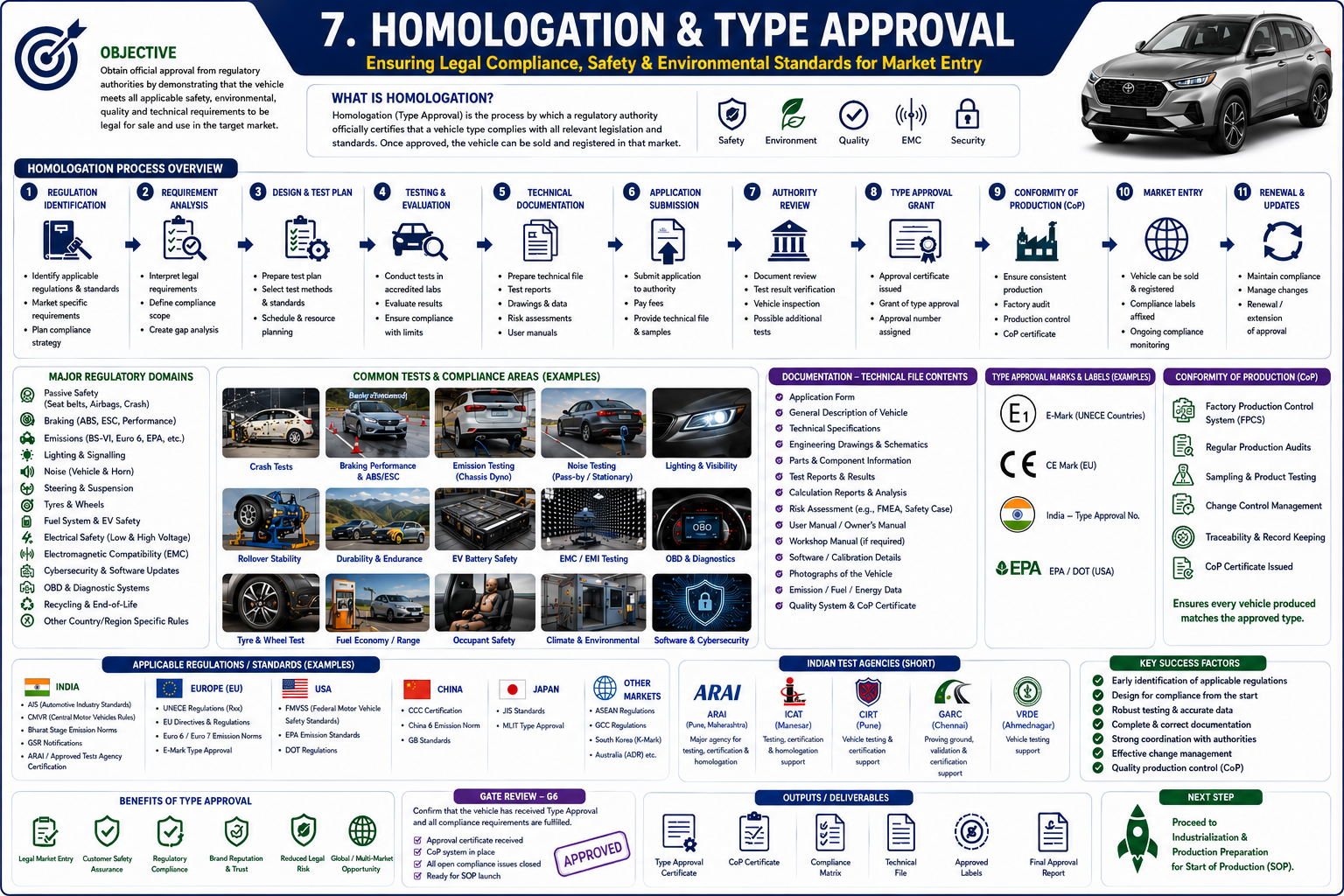
Homologation & Type Approval Process in Automotive Product Development
Ensuring Legal Compliance, Safety and Environmental Standards Before Market Entry
Homologation and Type Approval is one of the most important phases in the Automotive Product Development Process. It confirms that a vehicle, system, component, engine, trailer, construction equipment vehicle, agricultural tractor or electric vehicle complies with all applicable regulatory requirements before it is sold, registered or used in the target market.
A vehicle may be technically excellent, successfully validated and production-ready, but it cannot be commercially launched unless it receives the required regulatory approval. Homologation ensures that the vehicle meets legal requirements related to safety, emissions, noise, braking, lighting, electromagnetic compatibility, diagnostics, environmental protection and Conformity of Production.
In India, Type Approval is mainly carried out through approved testing and certification agencies such as ARAI, ICAT, CIRT, GARC and VRDE, depending on the vehicle category and test requirement. For Maharashtra and Pune-based OEMs, suppliers and importers, ARAI Pune is one of the most important and convenient Type Approval agencies, because it is located in Pune, Maharashtra and offers vehicle and component certification, testing, validation and homologation services. ARAI states that it provides certification and homologation services for the entire range of automotive vehicles, systems and components.
Functional safety and homologation support different obligations: ISO 26262 structures the safety argument for E/E malfunctioning behaviour, while type approval demonstrates compliance with applicable law. Functional Safety (FuSa) in Automotive explains how the disciplines interact without treating one as a substitute for the other.
1. What is Homologation?
Homologation, also called Type Approval, is the official certification process through which a regulatory authority or authorized testing agency confirms that a vehicle type complies with applicable legislation, technical standards and safety/environmental requirements.
Once approval is granted, the vehicle can be legally sold, registered and used in the approved market.
Homologation applies to:
- Complete vehicles
- Engines
- Vehicle systems
- Safety-critical components
- Electric vehicle systems
- Construction equipment vehicles
- Agricultural tractors
- Retro fitment systems
- Emission-related components
- Lighting and signalling devices
- Brake systems
- Tyres and wheels
ARAI’s official vehicle CMVR Type Approval page covers vehicle approval for 2-wheelers, 3-wheelers, 4-wheelers, electric vehicles, construction equipment vehicles, agricultural tractors and combined harvesters. (ARAI)
2. Objective of Homologation & Type Approval
The main objective is to obtain official approval by demonstrating that the vehicle complies with all applicable standards and regulations.
The process ensures that the vehicle meets:
- Safety requirements
- Emission limits
- Noise limits
- Braking requirements
- Lighting and signalling requirements
- EMC / EMI requirements
- OBD and diagnostic requirements
- Electric vehicle safety requirements
- Battery safety requirements
- Quality and production conformity requirements
- Country-specific regulatory requirements
In simple words, homologation answers the question:
“Is this vehicle legally approved for sale and registration in the target market?”
3. Importance of ARAI for Maharashtra-Based OEMs
ARAI – Automotive Research Association of India
ARAI is located at Kothrud, Pune, Maharashtra, and is one of India’s leading automotive testing, certification and homologation organizations. The Ministry of Heavy Industries describes ARAI as a leading automotive R&D organization set up by the automotive industry with the Government of India, offering services such as Testing & Validation, Certification & Homologation, Design & Development, Standardisation & Harmonisation and Testing Solutions.
For OEMs, suppliers, importers and engineering companies based in:
- Pune
- Chakan
- Talegaon
- Ranjangaon
- Chhatrapati Sambhajinagar
- Nashik
- Mumbai
- Nagpur
- Kolhapur
- Other Maharashtra automotive hubs
ARAI is highly relevant because of its proximity and broad testing capability.
However, one important point must be clearly understood:
For Maharashtra and western India-based automotive manufacturers, ARAI Pune is one of the most convenient and widely used Type Approval and homologation agencies. Its approval services support national regulatory compliance under applicable Indian vehicle regulations.
4. Vehicle Categories Covered Under Homologation
Homologation applies to almost all automotive product categories.
4.1 Motorcycle / Two-Wheeler Type Approval
Two-wheeler homologation applies to:
- Motorcycles
- Scooters
- Mopeds
- Electric two-wheelers
- High-performance motorcycles
- Imported motorcycles
- Locally manufactured motorcycles
Common Approval Areas
- Emission testing
- OBD requirement, if applicable
- Noise test
- Brake performance
- ABS / CBS compliance
- Lighting and signalling
- Horn
- Rear-view mirror
- Tyres
- Speedometer/Odometer Calibration
- External projection
- Fuel tank safety
- Battery safety for electric two-wheelers
EMC for EVs and electronic systems, etc.
Typical Documents
- Technical specifications
- Drawings
- Engine details
- Brake system details
- Lighting layout
- Tyre details
- Component certificates
- Emission calibration data
- Owner’s manual
- COP plan
4.2 Four-Wheeler / Passenger Car Type Approval
Four-wheeler approval applies to:
- Passenger cars
- SUVs
- MPVs
- Electric cars
- Hybrid cars
- CNG / LPG cars
- Imported cars
- Locally manufactured cars
ARAI’s vehicle Type Approval page includes 4-wheeler vehicles such as passenger or goods carriers, fully built vehicles, drive-away chassis for certain categories, petrol/diesel/CNG/LPG vehicles, alternate-fuel vehicles and electric vehicles.
Common Approval Areas
- Emission certification
- Fuel consumption / CO₂, where applicable
- OBD compliance
- Braking and ABS / ESC
- Lighting and signalling
- Passive safety
- Seat belt and anchorage
- Airbag-related compliance
- Crashworthiness, where applicable
- Noise
- EMC / EMI
- Tyres and wheels
- Mirrors and visibility
- VIN and statutory plates
- COP requirement
4.3 Electric Vehicle Type Approval
Electric vehicle homologation applies to:
- Electric two-wheelers
- Electric three-wheelers
- Electric cars
- Electric buses
- Electric trucks
- Electric tractors, where applicable
- Hybrid vehicles
- Plug-in hybrid vehicles
Common Approval Areas
- Battery safety
- High-voltage electrical safety
- Protection against electric shock
- Insulation resistance
- Charging system safety
- Motor and controller safety
- EMC / EMI
- Vehicle range and energy consumption
- Regenerative braking
- Acoustic vehicle alerting system, where applicable
- Thermal safety
- Battery management system
- Software and diagnostics
- COP for battery and vehicle production
Important EV Documentation
- Battery technical specification
- Cell / module / pack details
- BMS details
- Charger details
- HV cable layout
- Thermal management details
- Electrical safety reports
- EMC reports
- Software and calibration details
- Battery warning labels
- COP documentation
4.4 Truck / Commercial Vehicle Type Approval
Truck homologation applies to:
- Light commercial vehicles
- Medium commercial vehicles
- Heavy commercial vehicles
- Goods carriers
- Tippers
- Trailers
- Tractor-trailers
- Special purpose vehicles
- Buses and coaches
Common Approval Areas
- Emission compliance
- Brake performance
- ABS / ESC, where applicable
- Speed limiting device
- Lighting and reflectors
- Rear underrun protection
- Side underrun protection
- Front underrun protection, where applicable
- Noise
- Tyres and wheels
- Load body compliance
- Cabin safety
- Mirrors and indirect vision
- Fuel system safety
- OBD / diagnostics
- Vehicle dimensions and axle loads
- COP requirement
Special Focus for Trucks
Commercial vehicles require special attention to:
- Gross vehicle weight
- Axle load distribution
- Braking efficiency
- Stability
- Chassis strength
- Body-builder interface
- Reflective markings
- Load body compliance
- Roadworthiness
4.5 Agricultural Tractor Type Approval
Agricultural tractor homologation applies to:
- Agricultural tractors
- Tractor variants
- Combined harvesters
- Tractor engines
- Implements, where applicable
ARAI’s vehicle Type Approval page specifically mentions Agricultural Tractor & Combined Harvester Type Approval and notes that agricultural tractors and combined harvesters are covered under CMVR because tractors are used not only in fields but also for transportation in rural infrastructure.
Common Approval Areas
- Engine emission compliance
- Brake performance
- Steering requirements
- Lighting and signalling
- PTO safety, where applicable
- Operator safety
- Rollover protection, where applicable
- Noise
- Tyres
- Dimensions
- Drawbar / towing requirements
- Speed limitation, where applicable
- COP requirement
Special Focus for Tractors
Tractors are different from normal road vehicles because they operate both on farms and public roads. Therefore, homologation must consider:
- Field operation
- Road operation
- Low-speed torque
- Pulling capacity
- Stability
- Operator protection
- Rural road conditions
- Agricultural usage pattern
5. Homologation Process Overview
The complete Type Approval process can be explained in 11 major steps.
Step 1: Regulation Identification
The homologation team identifies all applicable regulations and standards for the target vehicle category and market.
Key Activities
Identify vehicle category.
Identify fuel type or energy type.
Identify applicable CMVR rules.
Identify AIS standards.
Identify emission norms.
Identify safety requirements.
Identify component-level approvals.
Identify market-specific requirements.
Prepare initial compliance strategy.
Example
For a motorcycle, the applicable requirements may include emission, OBD, noise, brake, ABS/CBS, lighting, tyres, mirrors and external projection.
For an electric car, requirements may include battery safety, high-voltage safety, EMC, braking, lighting, crash safety, range and COP.
Step 2: Requirement Analysis
After regulation identification, the team interprets the exact requirements.
Key Activities
Interpret legal clauses.
Define test applicability.
Identify exemptions.
Define sample requirements.
Prepare compliance matrix.
Identify documents required.
Identify component certificates required.
Prepare gap analysis.
Output
The main output is a Regulatory Compliance Matrix.
This matrix should include:
Step 3: Design & Test Plan
The homologation team prepares a complete test plan.
Key Activities
Prepare Type Approval plan.
Decide official test agency.
Coordinate with ARAI / ICAT / CIRT / GARC / VRDE as applicable.
Confirm test sample quantity.
Confirm test schedule.
Confirm test facility.
Prepare documents.
Arrange prototype or production-intent vehicles.
Conduct pre-compliance tests.
For Maharashtra-based projects, the first agency often considered is ARAI Pune, especially when test facilities and approval scope match the product requirement.
Step 4: Testing & Evaluation
The vehicle is tested as per applicable standards.
Common Tests
- Emission test
- Noise test
- Brake test
- ABS / ESC test
- Lighting and signalling check
- Tyre and wheel check
- EMC / EMI test
- OBD test
- Safety test
- EV battery safety test
- Range / energy consumption test
- Tractor engine emission test
- Truck brake and load-related tests
Output
- Test report
- Observations
- Deviations
- Corrective action requirement
- Compliance status
Step 5: Technical Documentation
A technical file is prepared and submitted for approval.
Technical File Contents
- Application form
- General description of vehicle
- Technical specifications
- Engineering drawings
- Layouts and schematics
- Vehicle photographs
- Component details
- Test reports
- Calculations and analysis
- Risk assessment, where applicable
- Owner’s manual
- Workshop manual, where required
- Software and calibration details
- Emission data
- Fuel / energy consumption data
- Quality system documents
- COP plan
ARAI’s website lists typical CMVR Type Approval submission documents such as application letter, authorization letter, technical specifications as per AIS 007, drawings/layouts as prescribed under AIS 007, copies of Type Approval Certificates, COP certificates, BIS licence for safety-critical components and tentative submission date of test/prototype vehicles or components.
Step 6: Application Submission
The formal application is submitted to the Type Approval agency.
Key Activities
Submit application.
Submit technical file.
Submit test reports.
Submit drawings.
Submit component certificates.
Pay applicable fees.
Submit vehicle samples, if required.
Respond to queries.
The submitted documents must match the actual vehicle configuration. Any mismatch can delay approval.
Step 7: Authority / Agency Review
The agency reviews the application, documents, test reports and vehicle details.
Common Review Points
- Test results
- Vehicle specification
- Component certificates
- Drawing revision
- Regulatory compliance matrix
- Emission family
- Variant coverage
- Software / calibration version
- COP readiness
- Label requirements
- Approval scope
Common Queries
- Vehicle and document mismatch
- Component approval mismatch
- Incorrect drawing revision
- Incomplete test report
- Missing BIS / TAC / COP certificate
- Emission margin concern
- Lighting approval mismatch
- Tyre size mismatch
- EV battery report clarification
Step 8: Type Approval Grant
If all requirements are fulfilled, the Type Approval Certificate is issued.
Outputs
- Type Approval Certificate
- Approval number
- Approved specification
- Variant coverage
- Regulatory compliance confirmation
- Approval label requirements
- Final approval report
ARAI indicates indicative timelines for CMVR Type Approval services, including full-level vehicle Type Approval, partial-level Type Approval and documentation approvals, subject to correct document submission, timely prototype submission and component-level certification completion.
Step 9: Conformity of Production
After Type Approval, the manufacturer must prove that production vehicles continue to match the approved type.
COP Activities
- Factory production control
- Production audits
- Sampling and product testing
- Process control
- Change control management
- Traceability
- Record keeping
- COP certificate management
Importance
Type Approval confirms that the tested vehicle met the regulation. COP confirms that every production vehicle remains consistent with the approved specification.
Step 10: Market Entry
After Type Approval and COP readiness, the vehicle can enter the market.
Activities
Vehicle can be sold.
Vehicle can be registered.
Compliance labels are affixed.
Dealer documents are released.
Registration documents are prepared.
Owner’s manual is released.
Compliance monitoring starts.
Step 11: Renewal, Extension & Updates
Homologation must be maintained throughout the product lifecycle.
Activities
- Certificate renewal, where applicable
- Extension approval for variants
- Regulatory update monitoring
- Engineering change review
- Supplier change review
- Software / calibration change review
- COP continuation
- Approval record maintenance
Any change in component, supplier, software, calibration, tyre, lighting, brake system, emission system, battery, controller or manufacturing location may need homologation review.
6. Vehicle Category-wise Homologation Focus
Summary Table
7. Major Regulatory Domains
Homologation generally covers the following domains:
- Passive safety
- Active safety
- Braking
- Emissions
- Noise
- Lighting and signalling
- Tyres and wheels
- Steering and suspension
- Fuel system safety
- Electric vehicle safety
- Battery safety
- Electrical safety
- EMC / EMI
- OBD and diagnostics
- Cybersecurity and software updates
- Recycling and end-of-life
- Country-specific legal requirements
8. Common Homologation Tests
9. Stakeholders in Homologation
The homologation process requires strong coordination between:
- OEM / manufacturer
- Homologation team
- Design engineering
- Testing team
- Quality team
- Manufacturing plant
- Purchase team
- Suppliers
- ARAI / ICAT / CIRT / GARC / VRDE
- Regulatory authorities
- Certification bodies
- Dealers and importers
For Maharashtra-based OEMs, coordination with ARAI Pune can be highly efficient because of proximity, local technical interaction and availability of multiple automotive testing and certification facilities.
10. Benefits of Type Approval
Effective Type Approval provides the following benefits:
- Legal market entry
- Vehicle registration permission
- Customer safety assurance
- Regulatory compliance
- Brand reputation
- Lower legal risk
- Reduced recall risk
- Export opportunity
- Controlled production quality
- Improved trust with authorities and customers
11. Gate Review – Homologation Approval
The homologation phase should end with a formal gate review.
Review Checklist
- Type Approval Certificate received
- COP system in place
- Compliance matrix completed
- All open compliance issues closed
- Test reports approved
- Approved specification frozen
- Labels confirmed
- Technical file stored
- Production change control established
- Vehicle ready for SOP / market launch
The gate review confirms that the vehicle is legally ready for production and sale.
12. Common Homologation Risks
Typical risks include:
- Wrong vehicle category selection
- Late regulation interpretation
- Test vehicle not matching production vehicle
- Component certificate mismatch
- BIS licence mismatch for safety-critical parts
- Drawing revision mismatch
- Supplier document delay
- Emission test failure
- Noise test failure
- Brake test failure
- EMC failure
- EV battery safety concern
- Incomplete technical file
- Authority query delay
- COP readiness gap
- Late engineering change after approval
13. Best Practices
To ensure smooth homologation and Type Approval:
Start regulation identification from product planning stage.
Use ARAI / approved agency consultation early for India projects.
Prepare a detailed compliance matrix.
Conduct pre-compliance testing before official testing.
Freeze test vehicle configuration before submission.
Verify physical vehicle against drawings and documents.
Confirm component TAC / COP / BIS certificates.
Maintain software and calibration traceability.
Track all regulatory open points.
Establish COP system before SOP.
Review every design change for homologation impact.
Maintain approval documents in a controlled database.
Train design, purchase, quality, production and service teams on regulatory requirements.
Conclusion
Homologation and Type Approval is the legal gateway between vehicle development and market launch. It confirms that the vehicle satisfies all mandatory safety, environmental, technical and production conformity requirements for the target market.
For Indian automotive projects, and especially for Maharashtra/Pune-based OEMs and suppliers, ARAI Pune plays a major role in Type Approval, testing, certification and homologation support. ARAI’s services cover a wide range of vehicle categories including two-wheelers, four-wheelers, electric vehicles, commercial vehicles, construction equipment vehicles, agricultural tractors and combined harvesters.
A well-managed homologation process reduces launch delays, avoids legal risk, protects customers, supports regulatory compliance and improves brand reputation.
The final output of this phase is:
A legally approved vehicle with Type Approval Certificate, COP readiness, complete compliance documentation and approval labels ready for production and market entry.
Reference tables from the source chapter
| Requirement | Standard / Rule | Applicability | Responsible Team | Status |
|---|---|---|---|---|
| Emission | Applicable BS norm / CMVR | Yes | Powertrain / Homologation | Open |
| Braking | AIS / CMVR requirement | Yes | Brake Team | Open |
| Lighting | AIS / CMVR requirement | Yes | Electrical Team | Open |
| Tyres | BIS / CMVR requirement | Yes | Purchase / Design | Open |
| COP | CMVR requirement | Yes | Quality / Plant | Open |
Reference table 2
| Vehicle Category | Key Homologation Focus | Typical Agency Route |
|---|---|---|
| Motorcycle / Scooter | Emission, noise, brake, ABS/CBS, lighting, tyres, mirrors, external projection | ARAI / ICAT / CIRT / GARC as applicable |
| Passenger Car / SUV | Emission, crash safety, braking, lighting, EMC, OBD, fuel economy, COP | ARAI / ICAT / GARC / VRDE as applicable |
| Electric Vehicle | Battery safety, HV safety, EMC, range, charger, motor, BMS, software, COP | ARAI / ICAT / GARC as applicable |
| Truck / Bus | Emission, braking, ABS, dimensions, lighting, underrun protection, speed limiter, body compliance | ARAI / ICAT / CIRT / GARC as applicable |
| Agricultural Tractor | Engine emission, brake, steering, lighting, PTO safety, operator safety, ROPS where applicable | ARAI / CIRT / other approved agency as applicable |
| Construction Equipment Vehicle | Safety, emission, braking, lighting, road operation requirements | ARAI / ICAT / CIRT / GARC as applicable |
Reference table 3
| Test Area | Motorcycle | Car | EV | Truck | Tractor |
|---|---|---|---|---|---|
| Emission | Yes | Yes | Not tailpipe, but energy/range related | Yes | Yes |
| Noise | Yes | Yes | AVAS / noise as applicable | Yes | Yes |
| Braking | Yes | Yes | Yes | Yes | Yes |
| ABS / ESC | ABS/CBS as applicable | ABS/ESC as applicable | Yes | As applicable | As applicable |
| Lighting | Yes | Yes | Yes | Yes | Yes |
| EMC | As applicable | Yes | Critical | Yes | As applicable |
| OBD | As applicable | Yes | Diagnostics applicable | Yes | As applicable |
| Battery Safety | EV only | EV only | Critical | EV truck if applicable | EV tractor if applicable |
| Crash Safety | Limited / category-wise | Important | Important | Category-wise | Usually different requirement |
| COP | Yes | Yes | Yes | Yes | Yes |
Frequently asked questions
What is vehicle type approval?
It is the authority's confirmation that a vehicle type satisfies the applicable safety, environmental, security, and technical requirements for a target market.
When should homologation planning begin?
It should begin during product planning and concept work so requirements influence architecture, components, test samples, timing, budget, and documentation.
Does type approval end the compliance responsibility?
No. Manufacturers must control changes, maintain production conformity, preserve evidence, and complete renewals or updates required by the authority.
Related articles
Phase review toolkit
Why this phase matters
Homologation connects the production vehicle configuration to the legal evidence required for market entry.
Inputs, outputs and gate review
- Inputs: Applicability matrix, vehicle and component specifications, test configuration, declarations and approval plan.
- Outputs: Test reports, certificates, approved variant scope, conditions and controlled approval records.
- Gate-review summary: Confirm that the application, tested configuration, reports, certificate scope and production release describe the same vehicle.
Chapter Checklist
- Inputs are controlled and traceable
- Outputs have an accountable owner and approval status
- Open risks include containment, due date and decision authority
- Configuration and assumptions match downstream evidence
- Compliance and change impacts are recorded